Clay Is Worth It for Technical GTM Teams. For Everyone Else, Do the Math First.
Clay pricing review: Launch starts at $185/month, but CRM sync needs the $495/month Growth plan. What you will really pay, by enrichment depth and team size.
Updated 14 min read
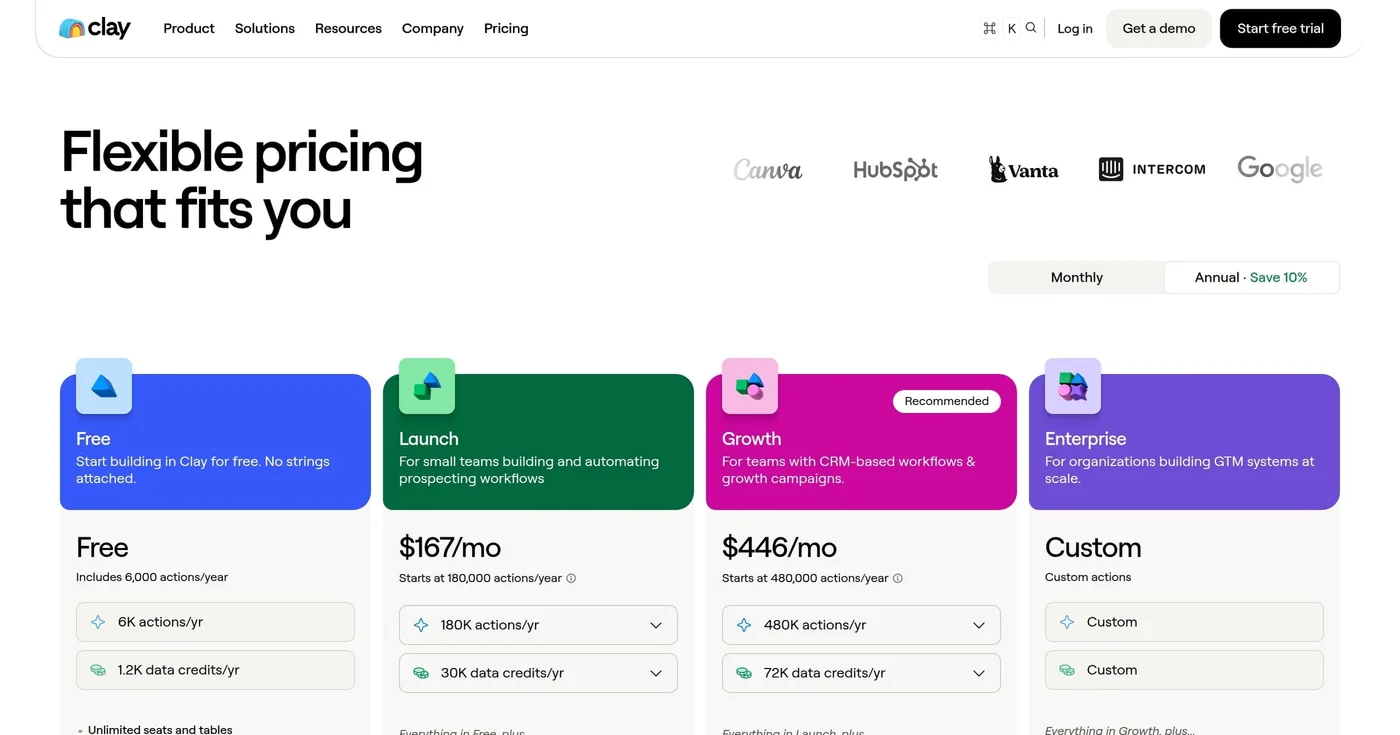
Clay costs $185/month (Launch) or $495/month (Growth) on monthly billing, and $167/month or $446/month billed annually. Any team that needs Salesforce or HubSpot sync pays at least $495/month, because CRM sync starts on Growth. In Saleshandy's modeled scenarios, the same 5,000 contacts cost $350 or $2,185/month depending only on which fields were enriched.
Clay overhauled its pricing on March 11, 2026, replacing three legacy self-serve tiers with Launch and Growth plus Enterprise. Clay is a B2B data enrichment and GTM automation platform that connects 150+ data providers in a waterfall model, letting you query multiple sources in sequence. Clay says more than 500,000 GTM teams use it.
This review covers the dual-meter billing system most buyers misunderstand, the CRM gating that sets the real entry price, four modeled cost scenarios, and when Clay earns its fee versus costs more than alternatives.
Key Takeaways
Verdict: Recommend for technical GTM teams enriching 1,000+ contacts/month; too expensive and complex for solo founders or low-volume workflows
Best for: RevOps teams, outbound agencies, and GTM engineers running enrichment workflows at scale
Pricing: $185/month (Launch), $495/month (Growth; required for CRM sync), about 10% less on annual billing
Biggest strength: 150+ data providers in one waterfall, unlimited seats on every plan, Data Credits that roll over
Biggest weakness: Two usage meters make monthly spend hard to forecast before your workflows settle
What Is Clay?
Clay is a GTM data enrichment and automation platform that began in Brooklyn in 2017 under founder and CEO Kareem Amin. Varun Anand joined as co-founder in 2021, and the company is headquartered in New York. Clay announced in December 2025 that it had crossed $100M in ARR, after raising a $100M Series C at a $3.1B valuation in August 2025.
A January 2026 employee stock sale put Clay's valuation at $5B. In September 2026, Clay raised a $115M Series D at a $7.1B valuation and said it has more than 17,000 customers.
The core workflow: instead of buying a single data vendor's contact list, you build a Clay table that queries multiple providers in sequence. It enriches only the gaps, applies AI research via Claygent, and pushes the result to your CRM.
That orchestration value is also why billing surprises new users. Clay charges for what it does, not who uses it: unlimited seats on every plan, including Free, means a five-person team and a fifty-person team pay the same plan price. The variable is how deeply you enrich each record.
Clay Pricing & Plans
Plan
Monthly
Annual
Data Credits/Month
Actions/Month
Key Gate
Free
$0
$0
100
500
200 rows/table max; no phone enrichment
Launch
$185
$167/mo
2,500
15,000
50,000 rows/table; no CRM sync, no HTTP API
Growth
$495
$446/mo
6,000
40,000
CRM sync, HTTP API, webhooks, web intent signals
Enterprise
Custom
Custom
Custom
Custom
SSO, RBAC, data warehouse sync, Growth Strategist
Annual billing saves 10% on Clay's pricing page, and annual plans get all their credits up front. On annual billing, each plan price is an Actions tier plus a Data Credits tier. Launch starts at 180,000 Actions/year ($54/month) plus 30,000 Data Credits/year ($113/month), which is the $167/month list price.
Growth starts at 480,000 Actions/year ($185/month) plus 72,000 Data Credits/year ($261/month), which makes $446/month. Growth's Data Credits tier scales to 120,000/year ($413/month), 240,000/year ($792/month) and 600,000/year ($1,913/month).
Clay offers a 14-day free trial with 1,000 Data Credits and access to webhooks, CRM integrations, email sequencers and HTTP API. Phone number enrichment isn't available during the trial.
The CRM gate matters most. CRM auto-sync and enrichment for Salesforce, HubSpot and other CRMs start on Growth at $495/month. Launch users can export CSVs, which uses no Actions or Data Credits, but they can't sync automatically.
For any production workflow that feeds a CRM, $495/month is the real floor, not $185/month. The price jump from Launch to Growth is $310/month, effectively the cost of adding a CRM connection.
What the March 2026 overhaul changed. Clay's legacy self-serve tiers were Starter ($149/month list), Explorer ($349/month with 10,000 credits) and Pro at $800/month. Legacy plans are closed to new sign-ups, but existing customers can stay on them. The key shifts:
CRM sync and HTTP API now start on Growth at $495/month, which Clay's memo calls more than $300 cheaper than legacy Pro
A legacy Pro customer whose usage fits Growth's allowances would pay $3,660/year less ($305/month × 12)
Former Explorer users who relied on HTTP API need Growth, which costs $146/month more than Explorer's $349
Clay says it cut the cost of data in its marketplace by 50–90%
When an enrichment returns no result, you aren't charged Data Credits or Actions
Negotiated contract data.Vendr data from 102 Clay purchases shows a median of $60,210/year, ranging from $16,800 to $154,000.
The Dual-Credit System: Data Credits vs. Actions
Since March 2026, Clay runs two billing meters at once. Buyers who treat them as one are the ones surprised by their bills.
Data Credits pay for enrichment data from Clay's marketplace and for AI model runs. On monthly plans, unused credits roll over up to 2× your monthly allocation. On annual plans, up to 15% of your annual Data Credits roll over when you renew on the same or a higher tier.
When you run out mid-cycle, top-ups cost 30% more than your plan rate (50% on legacy plans). Each top-up is capped at $1,000, with a $5,000 maximum across all top-ups in any rolling 7-day window.
Actions pay for platform operations: each enrichment, AI run, CRM sync, HTTP API call and export to an external tool costs 1 Action. Clay's sequencer charges 1 Action per lead added to a campaign, not per email sent. Actions don't roll over and can't be bought as top-ups; if you hit the limit, you move up to a higher Actions tier.
Zona Zhang, Clay's monetization lead, explained the top-up logic in a December 2025 Chargebee interview. "A lot of self-serve customers are very cost-sensitive and they want to be in full control of how much they spend on Clay. So that's why our top-up model is actually very intentional."
Clay's docs say plan tiers are designed so 90% of customers don't hit their Actions limit. In practice: Data Credits are the meter to watch. Actions are a background constraint that rarely triggers unless you're running high-frequency enrichment in a short window.
The BYOK change that raised costs for power users. Connecting your own API keys (ZoomInfo, Apollo, OpenAI, Anthropic) still removes the Data Credit cost for those providers. Every run still uses 1 Action, and every HTTP API call costs 1 Action.
GTM consultant Jacob Tuwiner estimated on March 11, 2026 that heavy users who had run large volumes for a few hundred dollars a month could see a "5, 10, 20x increase" under the new model.
What doesn't use Actions: sourcing lists of accounts or contacts, CRM, data warehouse and webhook imports, Clay formulas and filters, scoring and normalization formulas, manual data entry, Sculptor, Send Table Data and Lookup Single Row. Importing first-party data and transforming data inside Clay cost neither Actions nor Data Credits.
What Your Enrichment Actually Costs Per Contact
The pricing page shows the plan fee. Your bill is driven by the credit cost of each enrichment.
Enrichment Type
Data Credits
Source
LinkedIn profile
0.5 per profile
Clay's worked example
Work email (Clay marketplace)
0.5 per email found
Clay's worked example
Email validation (select providers)
0
Clay's worked example
Fully enriched record (company, person, email, phone, AI)
6–20 total
Clay billing docs
Clay Helium (web research)
1
Clay AI pricing
GPT-4o (content generation)
1
Clay AI pricing
Claude 4.6 Opus (content generation)
7.5
Clay AI pricing
GPT-4o or Claude 4.6 Opus (web research)
Variable, billed at token cost
Clay AI pricing
Clay's worked example enriches 100 contacts with LinkedIn profiles and emails for 95 Data Credits. Data Credits start at $0.05 each and get cheaper as you grow, and a fully enriched record typically costs 6–20 Data Credits.
At that rate, 5,000 fully enriched contacts need 30,000 to 100,000 Data Credits, or $1,500 to $5,000 at the $0.05 starting price. That spend sits on top of your $495/month Growth fee.
The AI model variable. Running Claude 4.6 Opus for content generation across 1,000 rows costs 7,500 Data Credits at Clay's fixed rate, more than a full Growth month's base allocation of 6,000. Web research on frontier models is variable-priced at the provider's token cost with 0% markup, so test on 10 to 50 rows before a full run.
Real Scenarios: What Four Teams Actually Pay
Saleshandy modeled four teams in an analysis updated July 3, 2026, using monthly billing and Clay's own plan recommendations. Each plan cost below matches Clay's monthly price selectors: Launch with 6,000 Data Credits, for example, is $60 for Actions plus $290 for credits.
Team Type
Input
Data Enriched
Recommended Plan
Monthly Cost
Solo founder or first SDR
2,000 accounts, 5,000 contacts
People search, work email
Launch, 6,000 Data Credits
$350
RevOps or GTM team
1,000 accounts, 2,000 contacts
Person and company profile, AI research, tech stack, hiring signals
Launch, 20,000 Data Credits
$940
Cold email agency
1,000 accounts, 2,000 contacts
Company profile, CRM push
Growth, 6,000 Data Credits
$495
Agency with phone numbers
2,000 accounts, 5,000 contacts
People search, work email, profiles, phone numbers
Launch, 50,000 Data Credits
$2,185
The same 5,000 contacts cost $350 or $2,185/month. Enrichment depth drove the difference, not list size: Saleshandy puts the phone setup at about $0.44 per contact.
For larger teams, an April 2026 analysis by Amplemarket estimates a 25-user team at $75,000 to $120,000/year. That figure adds credit overages and four to five tools Amplemarket says Clay doesn't replace: longer email sequences, phone dialing, social automation and advanced deliverability. The figure comes from a competing all-in-one platform, so treat it as a ceiling: if you already own most of these tools, subtract their cost from Amplemarket's stack math.
Hidden Costs to Budget For
Five costs that are easy to miss on Clay's pricing page:
CRM integration gating. Salesforce and HubSpot auto-sync start on Growth at $495/month. Launch users must export CSVs instead.
Waterfall credit burn. At 6 to 20 Data Credits per fully enriched record, Launch's 2,500 monthly credits cover roughly 125 to 416 fully enriched contacts. A single deep enrichment run can use a month's allocation in one session.
Claygent AI cost spikes. Frontier models cost far more per row than Clay's own: 7.5 Data Credits for Claude 4.6 Opus content generation versus 1 for Helium web research.
Actions non-rollover. Actions reset each billing cycle with no carryover and no top-ups. Teams that front-load enrichment early in the month can only move to a higher Actions tier.
Top-up premium. When Data Credits run out mid-cycle, buying more costs 30% more than your plan rate. Upgrading your Data Credits tier carries no premium, so it is the cheaper route for regular needs.
Under the legacy plans, u/Reikoii asked on r/LeadGeneration: "Are you also struggling with the $300/month Clay bill just to use HTTP APIs?" Since March 2026, HTTP API access starts on Growth at $495/month.
Ease of Use and Onboarding
Self-serve plans don't include guided onboarding; Enterprise adds onboarding, co-building and a dedicated Growth Strategist. Everyone else learns through Clay University, the free community Slack and Clay Clubs in 90+ cities.
The spreadsheet-plus-workflow interface is powerful once internalized. Getting there costs both time and credits.
You pay for onboarding twice: in hours spent learning the platform, and in credits spent on exploratory runs.
u/chennis on r/sales described it as: "It's great to start and wonderfully flexible but burned a lot of money in the process."
The payoff for technical teams: once you understand waterfall logic and credit economics, you can build enrichment pipelines that would otherwise require several separate vendor subscriptions, each with its own contract and billing cycle. Unlimited seats across all plans (including Free) mean your entire team can collaborate at no additional headcount cost.
Clay Pros and Cons
Pros
150+ data providers in one waterfall. Query multiple sources in sequence without managing separate subscriptions.
Unlimited seats on every plan. One Growth subscription covers your entire team regardless of headcount, a material advantage over per-seat tools.
No charge for empty results. When an enrichment returns no result, Clay charges no Data Credits or Actions.
Data Credits roll over. Monthly plans bank unused credits up to 2× the monthly allocation; annual plans carry over up to 15% at renewal.
BYOK lowers data costs. Connecting your own provider API keys eliminates Data Credit costs for those providers, though Actions still apply on every call.
Cons
CRM sync locked to Growth ($495/month). The most critical integration for production workflows isn't available on the entry plan.
Bills are hard to forecast. Usage-based billing makes monthly spend swing with enrichment depth and volume.
Two-meter cognitive load. Managing Data Credits (with rollover and top-ups) alongside Actions (no rollover, no top-ups) adds complexity most competing tools don't require.
Steep learning curve. No guided onboarding below Enterprise; exploratory use during setup consumes real credits.
Who Should Use Clay?
Clay is ideal for:
Technical RevOps teams with dedicated capacity to build and maintain enrichment workflows: Clay rewards that investment with compounding efficiency
Outbound agencies running multiple clients through shared workbooks (unlimited seats make per-client marginal cost near zero)
Teams scaling GTM who want marketplace flexibility across 150+ providers without committing to one vendor upfront
BYOK-heavy users who connect existing data subscriptions to eliminate Data Credit costs for those providers
Teams consistently enriching 1,000 to 10,000 records/month, the range Clay sizes its Growth plan for
Clay is NOT ideal for:
Teams needing CRM integration on a limited budget: the real entry price is $495/month, not $185/month
Solo founders or individual SDRs doing low-volume, email-only lookups, where a simpler credit-based email finder is easier to budget
Teams with fixed-cost deliverables: usage-based billing makes precise budget forecasting structurally difficult
Organizations building GTM from scratch without RevOps capacity: the onboarding investment is substantial, and mistakes burn credits
In December 2024, under Clay's legacy pricing, @HyperSalesman described spending $800 on phone credits in one week, with roughly 24% of those lookups wrong. The same post went on to recommend a competing tool.
Clay's pricing is atrocious.
In 1 week, I spent $800 on phone credits (with ~24% being wrong).
Clay fanboys are going to comment on this explaining how I need APIs from other data tools to save $$$
Not happening.
I'm not buying Findymail, Prospeo, ContactOut, and Apollo
The post captured a persistent tension: Clay's waterfall is powerful when you know which providers to use in which order. Without that knowledge, you can burn hundreds of dollars on low-quality lookups before workflows are calibrated.
Clay Alternatives Worth Considering
Three platforms address the most common Clay tradeoffs:
Apollo.io: Best for teams wanting combined contact data and sequencing in one platform. Free plan available; Basic costs $49 per seat per month billed annually.
LeadMagic: Best for pay-per-result enrichment from one credit pool, with failed lookups free and credits from $0.0071 each.
Prospeo: Best for email and contact lookup without workflow automation overhead. Free plan with 100 credits/month; Starter from $37 per user per month billed yearly.
Clay Pricing: Worth It When Enrichment Depth Is Predictable
Clay's pricing page shows $185 and $495 as the monthly entry points. The real pricing story: your bill is driven by enrichment depth, not contact count; CRM sync forces production users to Growth; and the dual-meter system rewards teams who model their workflows before launch.
For technical GTM teams using Clay as an orchestration layer (running waterfalls across 150+ providers, automating enrichment, and syncing results to CRM), the compounding value justifies the cost. For teams without RevOps capacity, enriching at low volume, or needing predictable monthly spend, alternatives with simpler pricing will likely cost less and cause less friction.
Sales Navigator Core costs $119.99/month or $1,079.88/year; Advanced is $159.99/month or $1,799.88/year. Plans, discount math and the tools you still need.
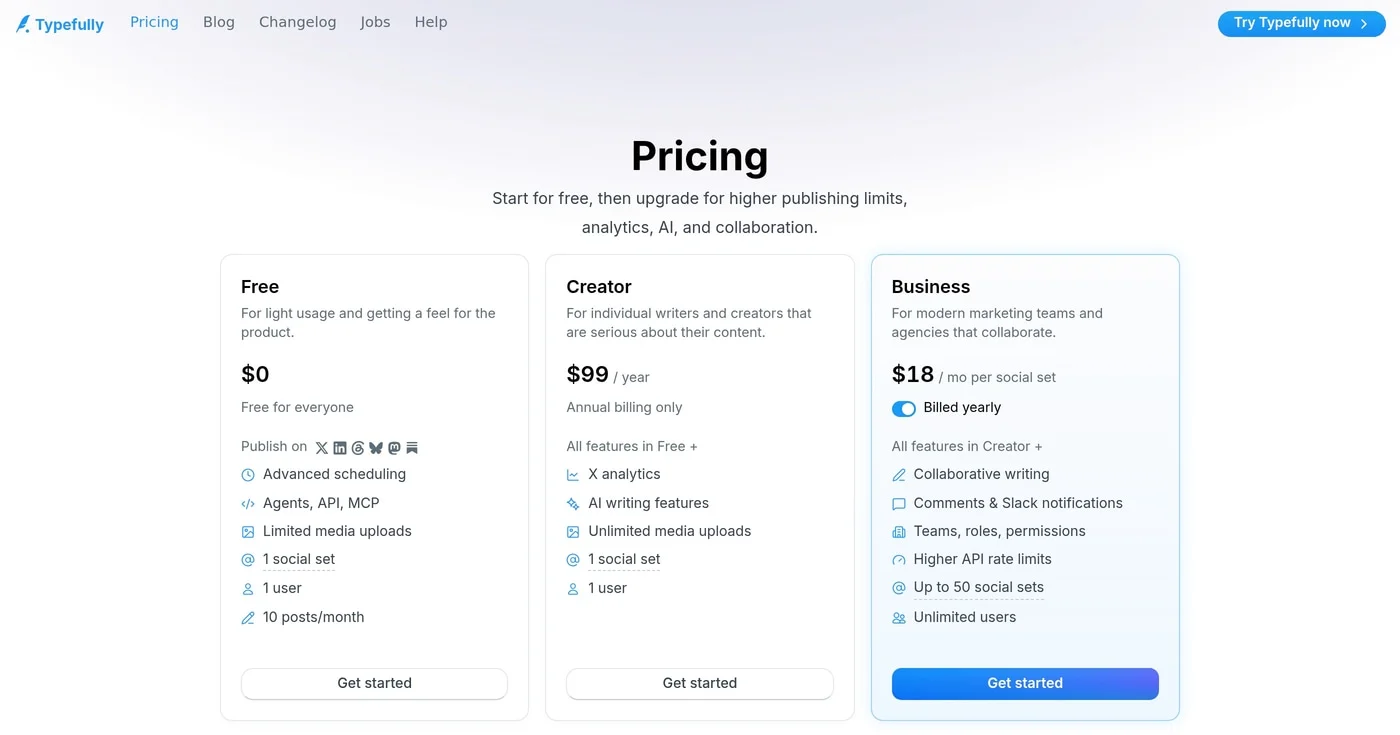
Free is $0, Creator is $99/year, and Business is $18 per set. Typefully pricing still excludes X Premium, LinkedIn analytics, and a monthly Creator bill.