
Stripe Pricing, Decoded: The 4–7% Reality Behind the 2.9% Headline
Stripe's advertised 2.9% + $0.30 rate applies to US domestic card transactions with no add-ons. For global SaaS, effective rates run 4–7%. Here's the complete f
Updated 16 min read

Stripe's advertised 2.9% + $0.30 rate applies to US domestic card transactions with no add-ons. For global SaaS, effective rates run 4–7%. Here's the complete f
Stripe is the right payment processor for most SaaS founders, and the one most founders are overpaying on. The advertised 2.9% + $0.30 rate applies to US domestic card transactions with no add-ons: it describes roughly 30% of a global SaaS's actual transaction mix. Add international cards, currency conversion, Stripe Billing, and Stripe Tax, and your effective rate typically runs 4–7%.
At $50,000 MRR, that gap adds up to approximately $17,400 per year in Stripe fees.
For most SaaS founders, Stripe is the default starting point, and often the right one. Whether you optimize your Stripe costs comes down to two things: understanding the full fee stack and asking for a volume discount.
Stripe's developer experience and global payment method coverage are best-in-class. Its add-on fee compounding, opaque negotiation process, and incomplete tax compliance tooling are where real money gets left behind.
Stripe is a payment infrastructure company founded in 2010 by Patrick and John Collison. It processes payments, manages subscriptions, handles fraud detection, and supports marketplace payments for businesses across 135+ currencies and 100+ payment methods. As of 2026, Stripe serves 5 million businesses, including OpenAI, Salesforce, and Amazon, and processed $1.9 trillion in payment volume in 2025, up 34% year over year.
Stripe started as a developer-friendly payments API and expanded into a full financial infrastructure stack. The core product has grown to include Stripe Billing (subscription management), Stripe Tax (tax calculation), Stripe Connect (marketplace payments), Stripe Radar (fraud detection), and Stripe Capital (merchant financing). Each product adds capability and, as this review covers in detail, an additional fee layer.
Stripe's February 2026 valuation of $159 billion, up more than 70% from $91.5 billion a year earlier, reflects its central position in the developer-first software economy. Its December 2025 acquisition of Metronome for approximately $1 billion extended Stripe into AI-scale usage billing, adding infrastructure that powers billing for OpenAI, Anthropic, NVIDIA, and Databricks.
For most SaaS founders, Stripe is not a choice made after evaluating alternatives. It's the default. This review is for those who want to know exactly what that default costs and how to optimize it.
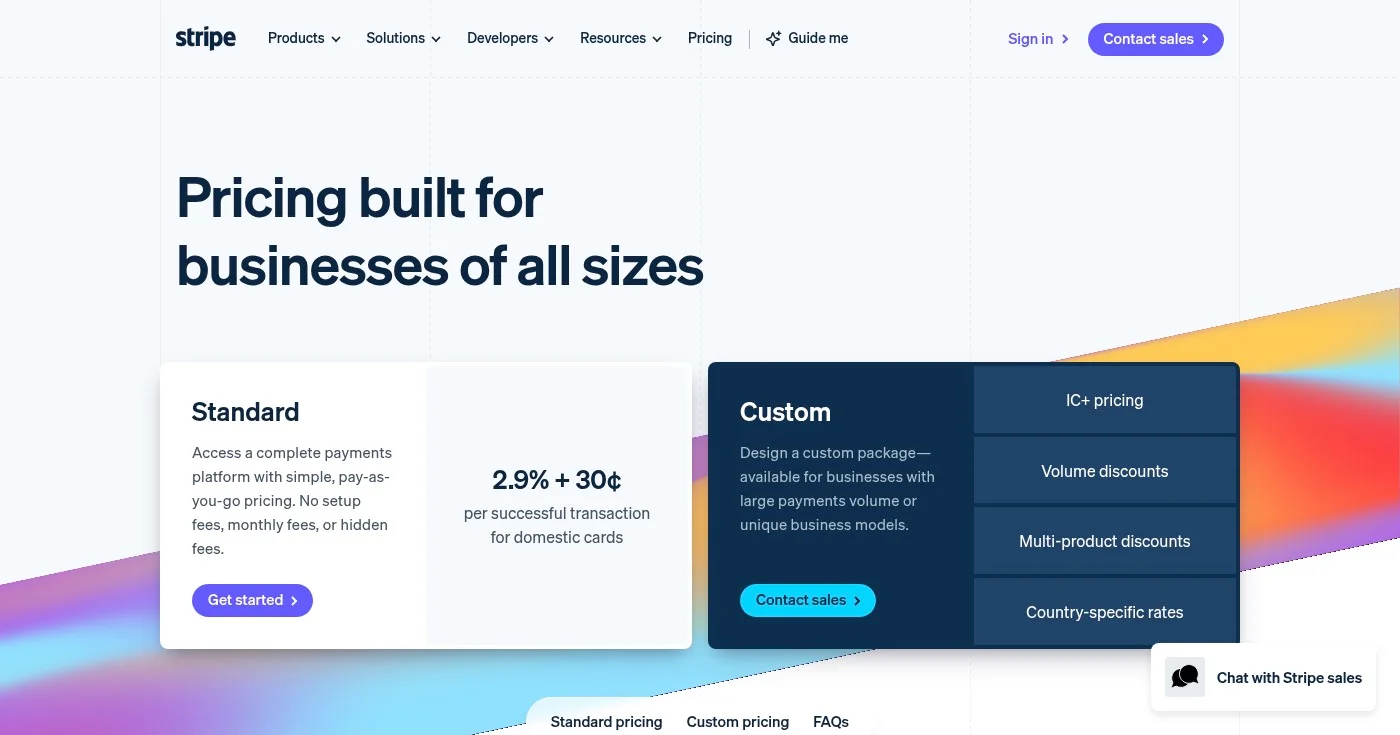
The headline is 2.9% + $0.30 per successful card transaction. You've seen it. What most "stripe pricing" articles don't show is what the full stack looks like when you process internationally, use Stripe Billing for subscriptions, and enable Stripe Tax.
Here's how fees compound on a single international SaaS subscription transaction:
Fee layer | Rate | Cumulative |
|---|---|---|
US domestic card, online | 2.9% + $0.30 | 2.9% |
International card surcharge | +1.5% | 4.4% |
Currency conversion | +1.0% | 5.4% |
Stripe Billing (PAYG) | +0.7% | 6.1% |
Stripe Tax | +0.5% | 6.6% |
At 6.6% + $0.30, that international subscription transaction costs more than double the advertised rate. This doesn't include disputes ($15 non-refundable), Radar for Fraud Teams ($0.02–$0.07 per screened transaction), or Instant Payouts (1.5%).
The international surcharge applies based on the card-issuing country, not the customer's billing address. A UK customer using a UK-issued card and paying in USD triggers the +1.5% surcharge. A UK customer switching to SEPA does not.
The flat per-transaction fee hits micro-transactions hardest. A $10 transaction carries a 5.9% effective rate after the $0.30 charge. A $500 transaction drops to 2.96%. If your product has any entry-level pricing tier in the $5–$15 range, the transaction fee is eating a disproportionate share of that revenue.
The MRR reality check. At $10,000 MRR with a typical global SaaS customer mix, Freemius calculates effective Stripe rates of 7.79–12.27%, nearly three times the advertised 2.9%. At $50,000 MRR, a 506-upvote thread in r/SaaS from March 2026 crystallized what many founders calculate for the first time in a dashboard: approximately $17,400 per year in Stripe fees.
One cost that's easy to miss: Stripe has not reversed the processing fee on refunded transactions since April 2020. When you issue a refund, the original 2.9% + $0.30 does not come back. For products with any non-trivial refund rate, this is a real line item.
Stripe Billing is the subscription and invoice management layer. For SaaS founders running recurring billing, it's the second-most relevant part of the pricing picture after base transaction costs.
The standard rate is 0.7% of total billing volume on a pay-as-you-go basis. This consolidated from a two-tier structure (Starter at 0.5%, Scale at 0.8%) in July 2024. The 0.7% applies to subscription revenue processed both on and off Stripe, a cut stacked on top of the per-transaction processing fee.
For 0.7%, you get Smart Retries (ML-optimized failed payment recovery), automated dunning sequences, a customer portal, revenue recognition, credit grants for promotional and prepaid balances, and Stripe's Meters API for usage-based billing. For most subscription businesses under $100K MRR, the 0.7% is the most straightforward path to proven retry logic and subscription management without building in-house.
Monthly subscription plans are available as volume-tiered annual contracts; see stripe.com/billing/pricing for current rates, since Stripe updated this area in 2026. A custom domain for your billing portal is available at an additional $10/month.
The gateway-only trade-off. On r/SaaS, a recurring architectural recommendation involves using Stripe purely as a payment rail, building billing and subscription logic in-house, and avoiding the 0.7% Billing fee entirely. The appeal is real: at $500K ARR, 0.7% is $3,500/year saved.
Multiple engineers push back. Subscription logic accumulates hidden complexity: 3DS compliance, webhook reliability, payment method update flows, double-billing edge cases. One commenter documented five years of full-time engineering work still yielding ongoing maintenance anxiety.
At most SaaS scales, 0.7% is cheaper than the engineering cost.
Stripe publishes one rate: 2.9% + $0.30. Volume discounts exist. Stripe does not make this obvious.
The commonly cited threshold for enterprise and IC+ (interchange-plus) pricing is $5M+ per year in processing volume. This comes from third-party analysis and community reporting; Stripe does not publish an official threshold. The community experience tells a different story: the practical starting point for a volume discount conversation is approximately $10,000–$20,000 MRR, not $100,000 per month.
On r/SaaS, practitioners document specific outcomes. One contributor reported a 30-basis-point rate reduction after $8 million in cumulative processing over five years, triggered at the $100,000/month MRR checkpoint. The top-voted advice across multiple fee optimization threads: call Stripe directly and request a rate review, citing your current volume and growth trajectory.
Community consensus is that at volume, few founders pay the listed standard rate.
The same community also documents a pattern: Stripe consistently moves the next milestone goalpost approximately 20% above current revenue. The negotiation is relationship-dependent with no published tier below standard. You can influence the outcome, but there is no transparent path through it.
Three optimizations that compound:
1. ACH Direct Debit for US B2B customers. Stripe's ACH rate is 0.8%, capped at $5.00. On a $500/month enterprise subscription, ACH costs $4.00 versus $14.80 on card, a 73% reduction per transaction.
One r/SaaS founder documented 15% ACH adoption at checkout with minimal friction changes, producing $340/month in total fee savings across negotiation, ACH enablement, and billing date batching.
2. Multi-region Stripe accounts. Setting up a Stripe account in the EU or UK for European customer billing eliminates the 1.5% international card surcharge on EEA transactions. A self-identified billing PM in r/SaaS (45 upvotes) describes this as the highest-leverage move for SaaS businesses with meaningful European revenue.
Your European customers pay in local currency, your UK or EU entity settles without the cross-border markup, and your effective rate drops accordingly.
3. Rate negotiation at $10K MRR. Do not wait for $100K/month. The community-documented floor for a productive conversation is considerably lower than official guidance implies.
The worst outcome from calling early is that Stripe says no. The best outcome is a rate that compounds across every dollar of growth from that point.
Stripe's international fee structure contains one of the most significant and least-discussed cost levers available to global SaaS founders.
EU and UK-incorporated businesses pay roughly half the US card processing rate:
Business entity / card combination | Rate |
|---|---|
US business, US domestic card online | 2.9% + $0.30 |
EU business, EEA card | 1.5% + €0.25 |
UK business, EEA card | 1.5% + £0.20 |
EU business, SEPA Direct Debit | 0.8%, capped at €5.00 |
US business, international card | 4.4% + $0.30 |
An EU-incorporated SaaS with predominantly European customers processes those transactions at roughly half the US standard rate. Stripe does not prominently advertise this asymmetry in its standard pricing documentation.
For US-incorporated businesses processing internationally, both surcharges stack independently. A UK customer paying in USD triggers the +1.5% international card surcharge and the +1.0% currency conversion fee: +2.5% on top of the base 2.9%. The currency conversion fee applies when settling in a currency different from the customer's card currency; these are two separate charges that combine.
Stripe's Adaptive Pricing Engine (May 2026) automates local currency presentation, exchange rate disclosure, and payment method localization at checkout. It charges the customer a disclosed 4% conversion fee and settles the merchant in base currency. For large product catalogs where managing per-currency SKUs was previously impractical, this solves a real operational problem: the 4% customer-facing charge is transparent but real.
The part of Stripe's pricing picture that most existing reviews miss entirely is what changed in the last 12 months.
Token billing for AI products (March 2026). Stripe now lets AI developers meter, bill, and mark up LLM inference costs with two lines of code. Jeff Weinstein, Stripe's head of product, described the mechanic:
.@stripe is building a way for developers to completely automate billing for tokens: 1/ pick model (e.g. openai o3, claude sonnet 4, gemini 1.5 flash, etc) 2/ set margin (e.g. charge +10% over inference) 3/ add two lines of code to your app want to try it? jweinstein@stripe.com
This removes a custom engineering problem that every AI founder was previously solving independently. A company charging customers for Claude Sonnet usage had to build metering, billing, and markup logic separately. Stripe now handles all three; ElevenLabs expanded its billing to token-based pay-as-you-go as an early production showcase.
Metronome acquisition (December 2025, approximately $1 billion). Stripe's native Billing cannot handle AI-scale usage pricing: ramped contracts, pooled credit balances, parent-child account hierarchies, and metering above 1,000 events per second. Metronome (which powers billing for OpenAI, Anthropic, NVIDIA, and Databricks) was acquired to close this gap. Metronome integration pricing is contact-sales; the capability now sits inside Stripe's platform.
Dispute fee restructure (June 2025). The change received limited coverage but it is material. The new structure: $15 per dispute received (non-refundable), +$15 to submit evidence (refunded if you win), and 30% of recovered funds if you use Stripe's Smart Disputes AI tool.
The previous structure was simpler and lower. For any business with non-trivial chargeback exposure, this restructure has real cost implications that compound at scale.
Agentic Commerce Protocol (September 2025, co-developed with OpenAI). Stripe is the first payments platform embedded in ChatGPT's Instant Checkout. Machine-to-machine transactions (AI agents purchasing on behalf of users) will route through Stripe infrastructure. This positions Stripe as the payment layer for the next generation of software interactions, not just human checkout flows.
Stripe's primary competitive advantage is its product quality. The pricing is competitive but not exceptional; the developer experience is the reason founders stay long after the fee calculations make them curious about alternatives.
The r/SaaS consensus on reliability: "Stripe just works. Every single time." Failed payment migrations are consistently framed as more expensive than years of processing fees. The community also documents what direct processor integration looks like in comparison: 10–20% rolling reserves, complex compliance requirements, brittle integration patterns.
The public review picture is divided. Stripe's Trustpilot rating is 1.8/5 from 17,000+ reviews, driven primarily by merchant complaints about Stripe's risk engine triggering account holds with limited recourse. Developer ratings on G2 and Capterra cluster around 4.0–5.0/5.
The divergence maps cleanly to use case: developers and SaaS operators rate Stripe highly; merchants flagged by the risk engine (often without a clear escalation path) produce most of the negative reviews.
For SaaS founders, the relevant benchmark is the developer rating. If your business involves high-risk product categories, the risk-engine exposure is a real consideration that belongs in your evaluation.
Plan / Product | Rate | Notes |
|---|---|---|
Standard processing | 2.9% + $0.30 | US domestic card, online |
International card surcharge | +1.5% | Based on card-issuing country |
Currency conversion | +1.0% | When settling in different currency |
ACH Direct Debit (US) | 0.8%, cap $5.00 | Best rate for US B2B billing |
In-person (Terminal) | 2.7% + $0.05 | +1.5% for international cards |
Stripe Billing (PAYG) | +0.7% of billing volume | Monthly subscription plans available (volume-tiered; see billing/pricing) |
Stripe Tax | +0.5% per transaction | Calculation and collection only; no remittance |
Stripe Connect | $2/active account/month | + 0.25% + $0.25/payout |
Disputes | $15 received + $15 counter | 30% of recovered funds via Smart Disputes |
Instant Payouts | 1.5% (US) | Raised from 1% in June 2024 |
BNPL (Klarna) | 5.99% + $0.30 | |
Enterprise / IC+ | Custom | Widely reported threshold: ~$5M+/year |
Stripe's full pricing is published on stripe.com. The pricing page is worth reading in full; it's more comprehensive than most third-party summaries and documents product-specific rates that don't appear in the headline.
Value analysis: Stripe's standard rate ties Square (2.9% + $0.30 online) and beats PayPal (3.49% + $0.49). The more useful comparison for SaaS founders is total cost of ownership: standard Stripe (2.9%) plus Billing (0.7%) plus Tax (0.5%) totals 4.1% before international fees. That's roughly comparable to Paddle's all-in Merchant of Record rate of 4–5%, without Paddle's full tax compliance included.
Stripe is ideal for:
Stripe is NOT ideal for:
If Stripe isn't the right fit, these three cover the most common decision points:
Stripe is the right payment processor for most SaaS founders. Its API is the category standard; no self-serve competitor matches its global payment method coverage.
The pay-as-you-go model removes the barrier to starting. For AI product billing, Stripe's 2026 token billing and Metronome integration are the only self-serve options that handle LLM inference billing and enterprise usage-metering in the same platform.
The assumption that costs you money is the one most founders carry too long: that 2.9% + $0.30 is what you pay. For a SaaS with global customers, the real number runs 4–7% depending on your customer mix. At $50K MRR, that gap is approximately $17,400 per year.
The fee is predictable. Whether you're paying the right fee depends on whether you've asked.
At $10,000 MRR, call Stripe. Request a rate review. Enable ACH for US B2B customers.
If you have meaningful European revenue, evaluate a UK or EU entity for those transactions. None of this requires switching processors. All of it produces compounding savings.
Two genuine cases to leave: if full tax compliance is a constraint from your first EU sale, Paddle or Lemon Squeezy absorb it in their all-in rate without a second system. If you're above $5M/year in processing and haven't initiated the IC+ conversation, the economics have already shifted in Adyen's favor.
Free is $0, Creator is $99/year, and Business is $18 per set. Typefully pricing still excludes X Premium, LinkedIn analytics, and a monthly Creator bill.
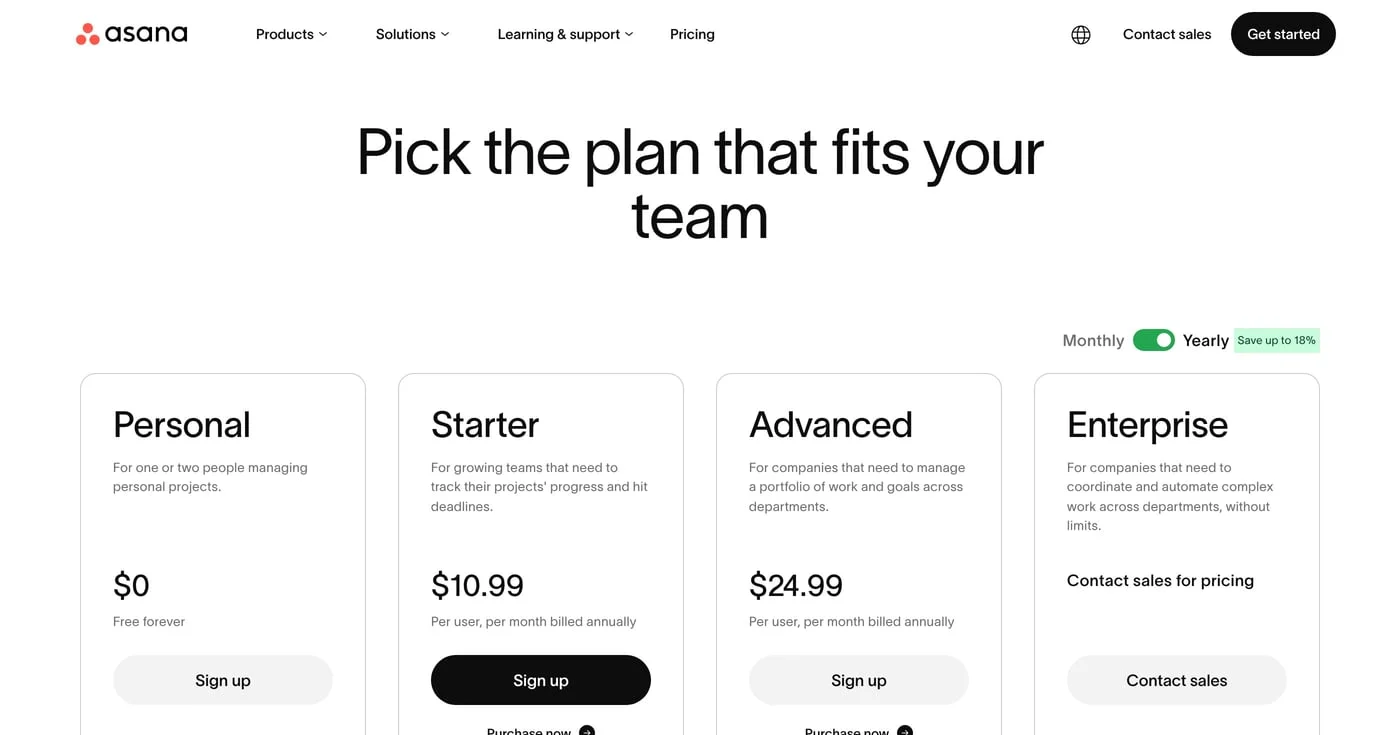
Asana pricing review: Starter is $10.99/user/mo yearly, but paid plans start at 2 seats and 6 people bill as 10. Plans, invoice math, monday.com vs ClickUp.
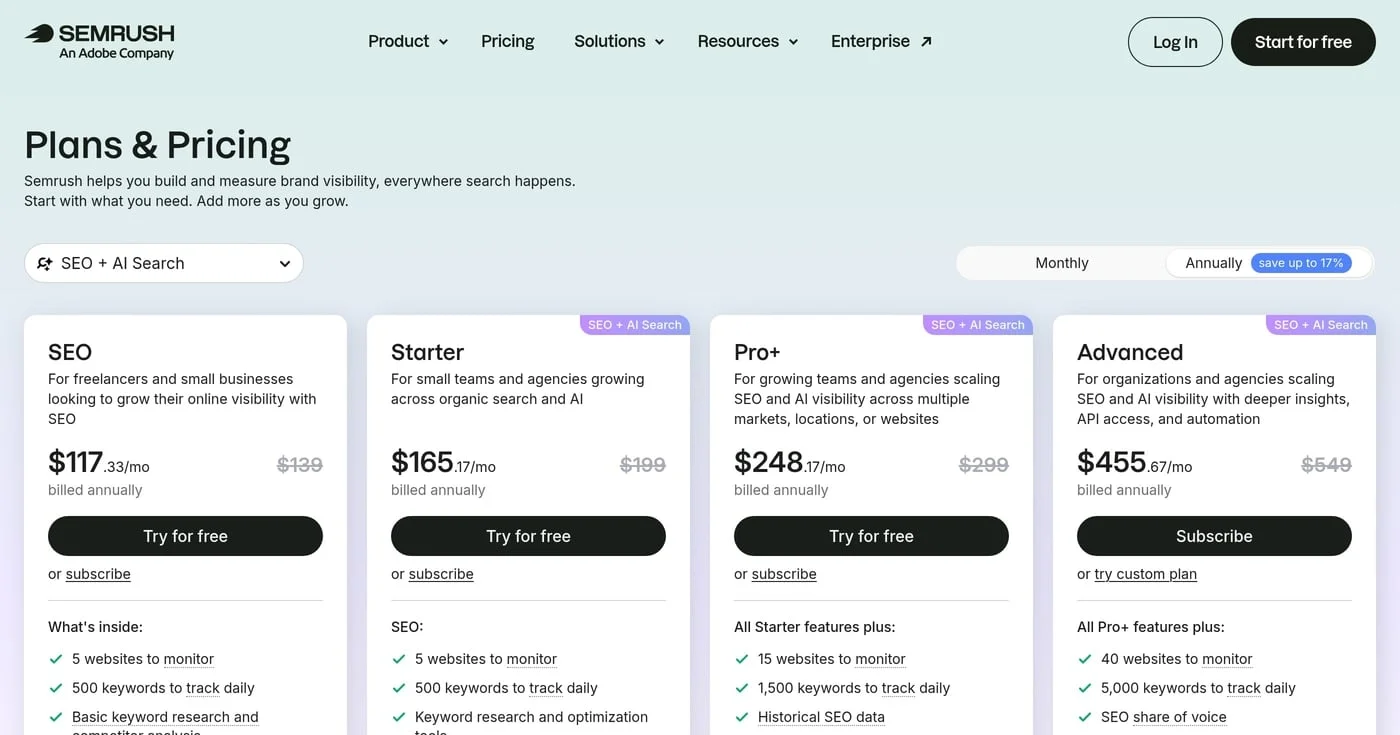
As of September 2026, Semrush SEO is $139/mo and Starter is $199. One seat is included; extra users, $99 AI Visibility, and toolkits set the real invoice.
