
VWO No Longer Publishes Prices. Budget From Real Contracts Instead
VWO pricing is now quote-only under the Wingify brand. See the Growth, Pro and Enterprise plans, how traffic quotas work, and what 103 buyers paid.
Updated 10 min read


VWO pricing is now quote-only under the Wingify brand. See the Growth, Pro and Enterprise plans, how traffic quotas work, and what 103 buyers paid.
VWO has no public price list. Since the 2026 merger with AB Tasty, vwo.com redirects to Wingify, whose pricing page offers "no fixed plans" and only a custom proposal. The best public benchmark is Vendr's purchase data: a median of $16,660 a year across 103 purchases.
VWO is a conversion optimization platform for A/B testing, personalization, behavior analytics and feature flags. It now sells under the Wingify name, and Wingify says existing VWO contracts and prices carry over unchanged. Rivals such as Convert still publish prices, starting at $299/month billed annually.
This guide covers what the official pricing page does and does not tell you, how the traffic quota is counted, what real buyers paid, and when a cheaper published-price tool is the better buy.
VWO (Visual Website Optimizer) lets marketing and product teams run A/B, split URL and multivariate tests, watch heatmaps and session recordings, personalize pages by audience, and roll out features behind flags. Paras Chopra founded the company, Wingify, in 2010 and ran it without outside funding until private equity firm Everstone bought a majority stake for about $200 million in January 2025. TechCrunch reported its annualized revenue at about $50 million at the time.
A year later, Everstone combined Wingify with AB Tasty, the French experimentation company. On September 16, 2026, the two products became one brand, Wingify, with more than $100 million in revenue, 4,000+ customers and 700+ people across 11 offices.
For existing customers, the rebrand changes the login and the invoices, not the contract. The VWO app moved to app.wingify.com on June 13, 2026, and Wingify's domain change FAQ says existing contracts, subscription terms and pricing stay unchanged. Invoices now come from a Wingify billing address.
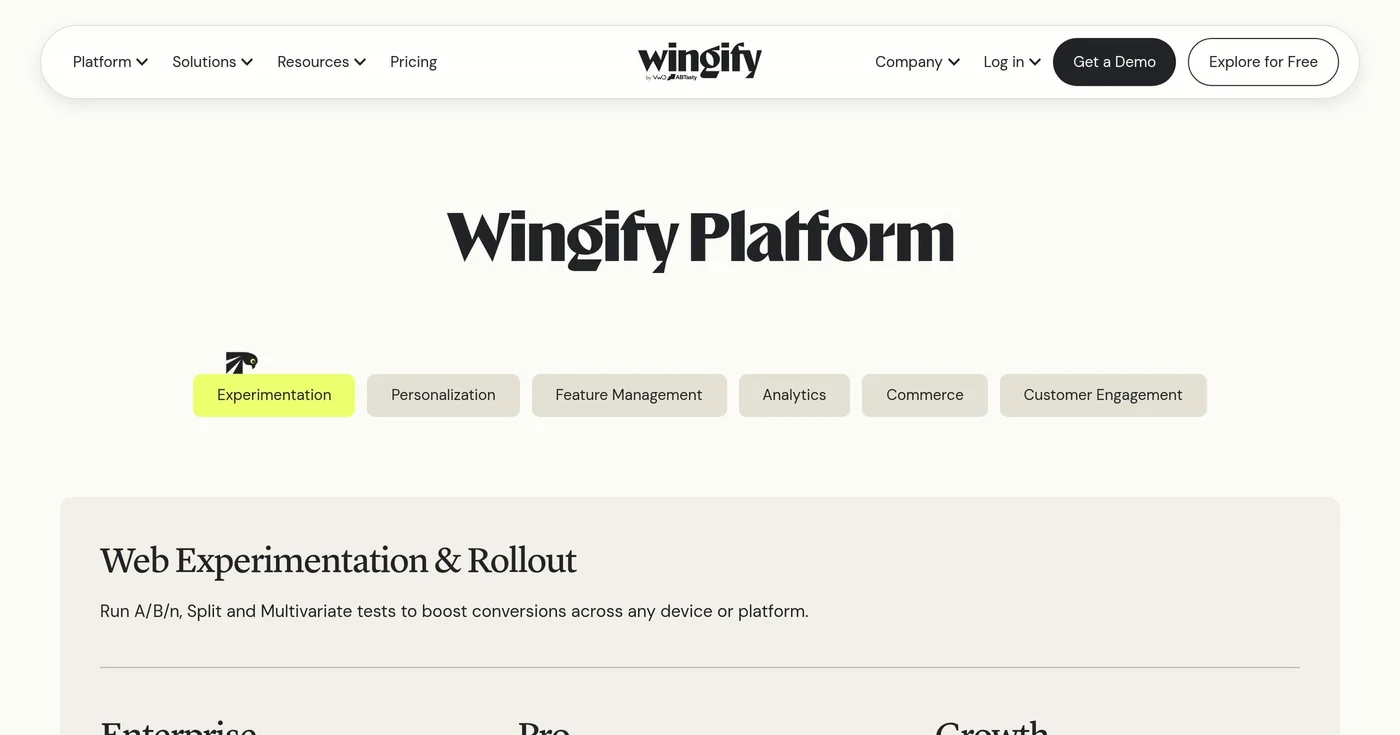
The Wingify pricing page lists every product with three plans (Growth, Pro and Enterprise), but no dollar amounts. Every plan button leads to "Schedule a Demo," and the page states it directly: "No fixed plans. Just a custom proposal built around your goals and scope."
According to the pricing FAQ, the quote depends on three things:
There is no free or Starter plan on the page. The entry point is a 30-day free trial with no credit card, plus a sample data account to explore. Wingify also says it gives discounts for product bundles and longer contracts, and preferential pricing to non-profits.
The pricing page splits the platform into separately priced products. Your quote is the sum of the ones you pick:
Product | What it does |
|---|---|
Web Experimentation & Rollout | A/B, split URL and multivariate tests, plus rollout campaigns |
Web Personalization | Targeted experiences for audience segments |
Feature Experimentation, Personalization & Rollout | Feature flags, rollouts and tests across any tech stack |
Behavior Analytics | Heatmaps and session recordings |
Journey Analytics | Funnels, metrics and journey maps |
User Feedback | Surveys across platforms and journeys |
Commerce | Site search and product recommendations |
Customer Engagement | Browser and web push notifications |
For most CRO programs, the useful pair is Web Experimentation plus Behavior Analytics, because heatmaps and recordings help explain why a variation won. Each added product carries its own plan tier and traffic quota, so a three-product stack is three line items, not one.
Wingz, Wingify's AI layer, comes in two levels. Wingz Core is free with every paid product and includes AI Analyze and an MCP connection to tools like ChatGPT and Claude (without Behavior Analytics data). Wingz Advanced is a paid upgrade that adds AI Workflow, AI Autopilot, Synthetic AB Test and MCP access that includes Behavior Analytics data.
For Web Experimentation & Rollout, the plans differ by feature, not by a published price:
Plan | Key features | Support |
|---|---|---|
Growth | Visual and code editor, unlimited experiments, variations and metrics, basic targeting, multi-armed bandit and rollout campaigns, QA Assistant, SPA support, Wingz AI Core | 24x5, 8-hour first response |
Pro | Everything in Growth, plus multivariate testing, cross-domain testing, guardrail metrics, sample ratio mismatch detection, advanced targeting and user collaboration | 24x5, 6-hour first response |
Enterprise | Everything in Pro, plus SSO, API access, self hosting, approval workflow, mutually exclusive groups and an ROI dashboard | 24x7, 4-hour first response |
The jumps that matter most: multivariate testing needs Pro, and SSO, API access and mutually exclusive groups need Enterprise. If your security team requires SSO, you are buying Enterprise regardless of traffic.
Behavior Analytics data retention also changes with the plan: 30 days on Growth, 60 days on Pro and 90 days on Enterprise. All other products keep data for 13 months. Saved recordings are capped at 100 on Growth, 250 on Pro and 1,000 on Enterprise.
Wingify's help article on visitor counting explains what uses up your quota. Four rules shape the bill:
Rule 1 favors sites that run many tests on the same pages. Rule 3 works against seasonal businesses: you size the quota for your peak month and pay for it in quiet months too.
What happens at the limit is only documented for rollouts. The Web Rollout quota FAQ says rollouts draw on your testing quota once their own runs out, and pause if there is none. Wingify's pages do not say whether testing campaigns pause or bill overage, so get that written into the contract.
With no list price, purchase data is the only public anchor. Vendr's VWO page reports a median annual cost of $16,660 across 103 purchases, with a low of $7,840 and a high of $36,590. Vendr says buyers saved 20% on average.
That works out to roughly $650 to $3,050 a month, with the median near $1,390 a month. Those figures cover whatever mix of products and traffic each buyer purchased, so they are a range to sanity-check a quote, not a price for your setup.
One larger deal shows how far negotiation can go: a buyer on PriceLevel reported paying $28,000 a year for Testing at Enterprise tier with up to 1.2 million visitors a month. The list price was $60,000, so that is a 53% discount on a multi-year contract signed in Q1 2023. PriceLevel has since shut down its pricing service, so treat that as one data point from before the merger.
Wingify's own FAQ names the levers: bundle products and sign longer contracts. Use both on purpose rather than by default.
VWO is ideal for:
VWO is NOT ideal for:
If a quote-only contract does not fit, these tools publish their prices:
For more vendor pricing breakdowns, see Mixpanel pricing and Mailchimp pricing.
VWO is a capable testing platform, and the merger has not changed what existing customers pay. But it has removed the last public price, so the only way to know your cost is a sales call.
Use Vendr's $16,660 median as your reference, size the quota from the visitors who will actually enter tests, and ask for bundle, multi-year and renewal terms in writing. If you cannot fill a yearly quota with tests, a published-price tool like Convert or GrowthBook is the safer buy.

Clay pricing review: Launch starts at $185/month, but CRM sync needs the $495/month Growth plan. What you will really pay, by enrichment depth and team size.

Sales Navigator Core costs $119.99/month or $1,079.88/year; Advanced is $159.99/month or $1,799.88/year. Plans, discount math and the tools you still need.

n8n Cloud starts at €20/month for 2,500 executions, but SSO and Git start at €667/month self-hosted. Every plan, price and execution rule, checked.
