
Semrush API Pricing Starts at $499.92. Units Set the Bill
Semrush API pricing review: the SEO API plan is $499.92/mo billed annually with 1M units included. Pack prices, v4 unit costs, and who should skip it.
Updated 16 min read


Semrush API pricing review: the SEO API plan is $499.92/mo billed annually with 1M units included. Pack prices, v4 unit costs, and who should skip it.
Semrush now sells a self-serve SEO API plan at $499.92/mo billed annually ($599 monthly) that includes the SEO Business plan and 1 million API units. Buy it if you are piping Semrush data into reports, products, or AI agents and will use that unit pool. If you only need the dashboard, stay on Semrush pricing.
The confusing part is that official Semrush pages still tell three slightly different stories about how you get in. This review maps those doors, the published pack prices, and what a unit buys on the current v4 endpoints, using pages opened on 26 November 2026.
The strength is that list prices are finally public. The weakness is that unused units expire, official docs still disagree on whether a Business upgrade starts at zero units, and mid-2026 pricing articles are already stale.
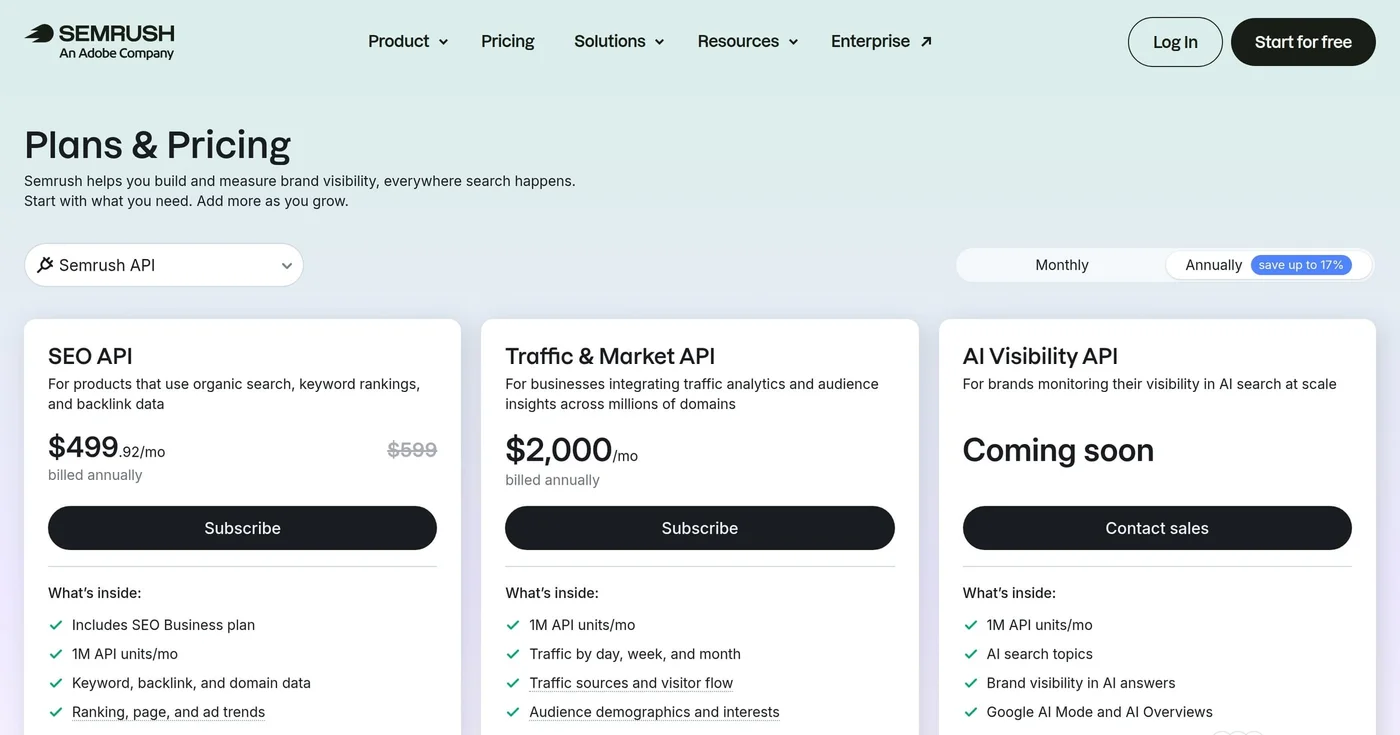
Semrush API is the programmatic way to pull Semrush search, traffic, market, and project data into dashboards, warehouses, products, and AI assistants, instead of exporting files from the app. The public API pricing page currently sells two live cards, SEO API and Traffic & Market API, and lists AI Visibility API as coming soon.
The same data powers the Semrush dashboard. SEO API covers keyword, backlink, domain, Position Tracking, SERP, and Site Audit methods.
Traffic & Market API covers traffic, sources, audience, and market rank. Semrush MCP uses those same APIs inside tools such as ChatGPT, Claude, Cursor, and Perplexity, and it spends the same unit balance.
Adobe completed its acquisition of Semrush Holdings on 28 April 2026. The same-day customer FAQ said there would be no immediate changes to access, support, or billing. For 2027 budgets, treat that as a snapshot from April, and re-check the live API pricing page when you renew, because Semrush already changed this story more than once in 2026.
On 25 November 2026, Semrush (@semrush) called this "the new Semrush API platform": up to 100 keys, a shared unit pool with per-user limits, MCP for assistants, and two APIs, SEO and Traffic & Market. That post matches the public cards better than the older "units unpublished" writeups still sitting on the search results.
Official Semrush pages opened on 26 November 2026 describe three ways in, and they do not collapse into one tidy flowchart. The honest move is to budget from the page that matches the door you will actually use, and to assume you may be asked for a second purchase.
The first door is the public SEO API card. It is $499.92/mo billed annually, or $599 monthly, and the card says it includes the SEO Business plan and 1 million API units per month. If that checkout is what Semrush sells you, the floor is no longer "qualify, then start at zero."
The second door is the developer access guide. It still says SEO API and Projects API require an SEO Toolkit Business subscription.
After you upgrade, "the number of units will still be zero" until you buy a pack under Subscription info and generate a key. The SEO API knowledge base says access is included in Business, Advanced, and Enterprise, after which you buy packs starting at 1 million units per month.
An official reply from u/semrush in r/SEMrush (September 2025) already described that sequence.
The third door is Semrush MCP. Starter, Pro+, SEO Classic Pro, and SEO Classic Guru include 50,000 API units that refresh on the renewal date.
Business and Advanced use MCP only with an API units package. MCP spends the same units as a direct API call, with no extra MCP fee.
The dashboard pricing page lists Advanced as custom, while SEO, Starter, and Pro+ remain self-serve at $139, $199, and $299 monthly ($117.33, $165.17, and $248.17 billed annually). If a sales page and a developer guide disagree, use the checkout you are offered that day.
Traffic & Market access is separate even when units are shared. The access guide is explicit: having API units does not grant every API. Listing Management (Local Pro or Business) and Map Rank Tracker do not require purchased API units, so do not budget a 1 million unit pack for those jobs.
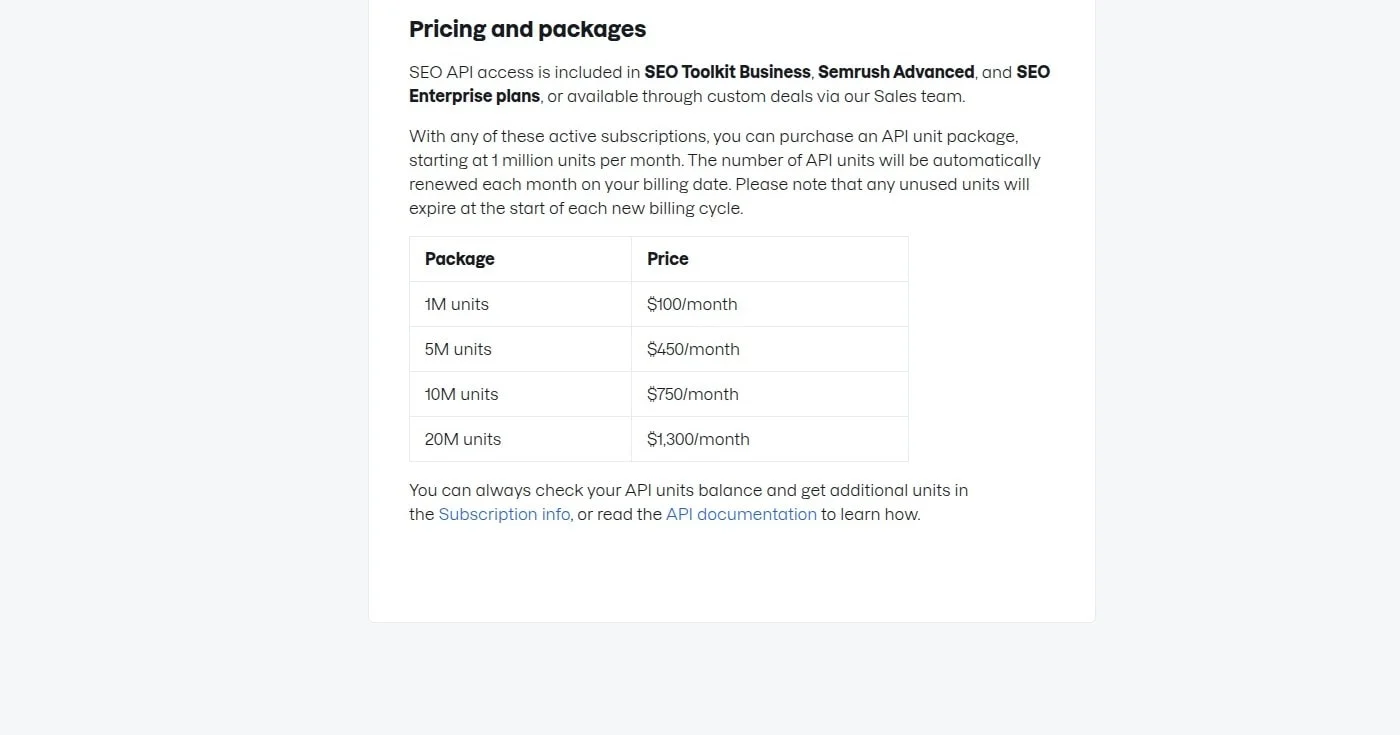
For teams already on an eligible plan, the SEO API knowledge base publishes add-on packs: 1 million units at $100/month, 5 million at $450, 10 million at $750, and 20 million at $1,300. The Traffic & Market article prints the same ladder and says the two APIs share one balance.
Units renew on the billing date. Unused units expire at the start of the next cycle. The public API pricing FAQ says unused units do not roll over.
If you divide those pack prices by the unit counts, the implied rates are $100, $90, $75, and $65 per million. Semrush does not print those rates. They only help if you will actually consume the pack, because a quiet month is a wasted month.
There is a real conflict on pack size. The knowledge base starts at 1 million units. The MCP overview lists packages of 2 million, 5 million, 10 million, or 20 million, with no dollar prices on that page.
The public SEO API card includes 1 million units in the plan price. All three were official on 26 November 2026. Do not invent a single model Semrush did not publish.
Confirm the pack you can buy inside Subscription info before you model a 2027 invoice.
The knowledge base also documents the control model Semrush now leads with: up to 100 API keys, a single shared unit pool, and a monthly per-user limit set by the account owner.
Operational calls such as creating or deleting keys do not consume units, and requests that return no data are free. That is useful, but it does not make the meter cheap. It only means you are not paying units to administer keys.
On r/SEMrush, the recurring frustration is this second bill: a Business plan with a zero unit balance, then an add-on charge. Official docs now give you a public table, but you still have to know which door you are on before that table applies.
A unit is not a request. The glossary defines it as the currency a call consumes. Cost varies by request type, lines returned, and other considerations.
The access guide adds that historical-data pricing also varies by endpoint. Always read the price line on the method you will call.
On the v4 pages opened today, Get Keyword Metrics costs 20 API units per request. List Broad Match and List Related cost 40 API units per line.
In Domain Analytics, Get Monthly Organic Positions costs 10 API units per line, and several "total" methods cost 10 units per request. Some paid-search competitor methods cost 80 units per line.
Backlinks methods commonly cost 40 or 45 units per line, with Score Profile at 1 unit per line.
Those current figures change the worked examples you will still see on competing articles. Several ranking pages still say a live domain organic keyword line costs 10 units and a historical line costs 50. The 50-unit historical price was not on the v4 method pages opened for this review, so this article does not repeat it as a current official figure.
The useful math uses today's 10 units per line and 40 units per line prices against the 1 million units included on the SEO API card.
At 10 units per line, 1 million units buys 100,000 lines of Get Monthly Organic Positions. At 40 units per line, the same pool buys 25,000 List Related lines. Pull 1,000 related keywords for 50 seeds and you have already spent 2 million units at the 40-unit rate.
Plan in lines, not just requests, and include every step in a workflow. The unit balance guide (updated 20 November 2026) tells you to check remaining units under Subscription info and to use the API Queries log for report cost after each call.
If you run out, behavior is endpoint-specific. Do not assume a polite partial response. Size the pack before you wire a cron job to production.
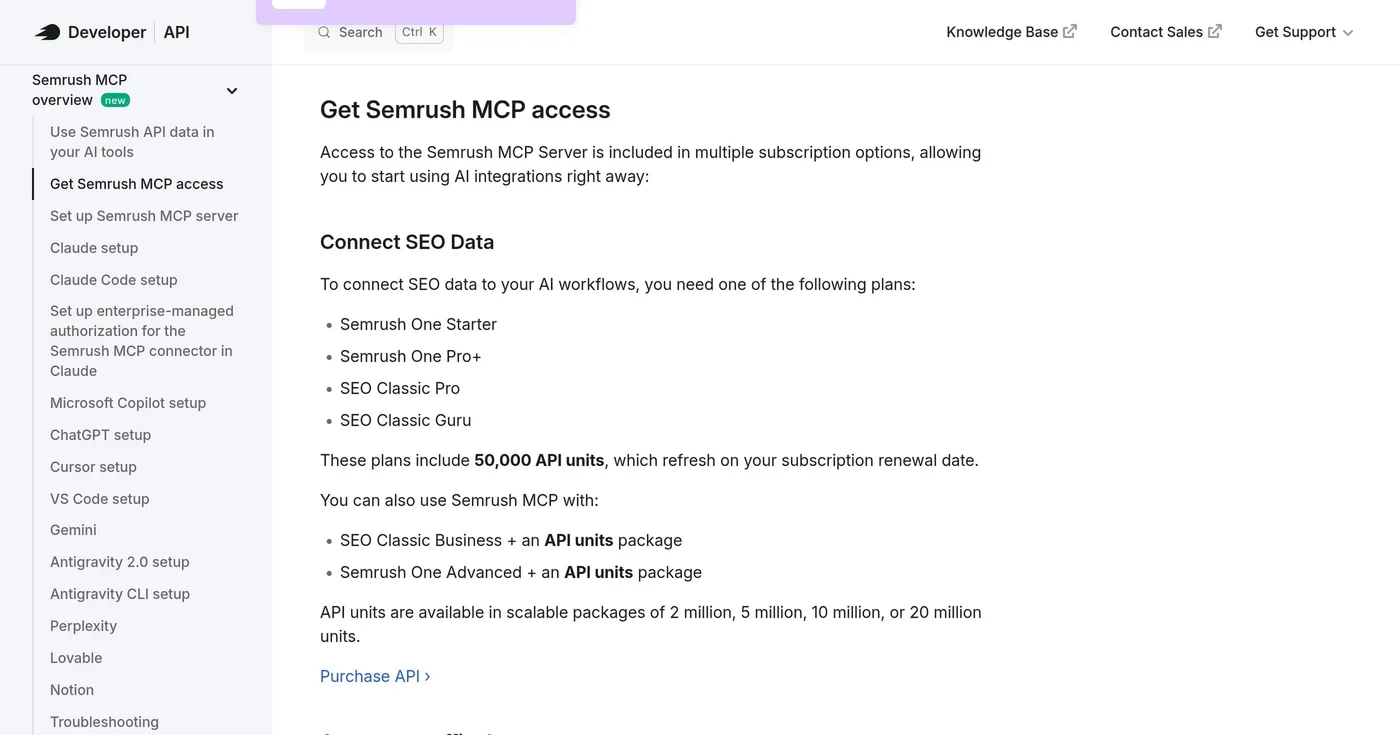
Semrush MCP is not a separate product with its own fee. The official MCP overview says requests use the same API units as direct calls, with no additional MCP usage fee. What changes is the qualifying plan and the size of the included pool.
Starter, Pro+, SEO Classic Pro, and SEO Classic Guru include 50,000 API units that refresh on the renewal date. That is the official confirmation of a claim some 2026 blogs already made, and it names the plans.
It is also a small pool. At 10 units per line, 50,000 units cover 5,000 Get Monthly Organic Positions lines. At 40 units per line, they cover 1,250 List Related lines.
That is enough for an assistant that looks up a handful of keywords or domains. It is not an agency reporting pipe.
The same page says you can also use MCP with SEO Classic Business or Semrush One Advanced plus an API units package. That is closer to the full API-key path, not the 50,000-unit mid-tier allowance. Do not assume a Starter subscription gives you a production key and a million-unit pool because MCP is "included."
Supported clients listed today include Claude, Claude Code, Microsoft Copilot, ChatGPT, Cursor, VS Code, Antigravity, Perplexity, Lovable, and Notion. Most use OAuth.
Traffic reports through MCP still depend on your Traffic & Market access. If you need that dataset in an agent, budget the $2,000/mo Traffic & Market card, not the 50,000-unit SEO allowance.
For a founder already on Pro+ who only wants Claude to pull a few Semrush metrics, this mid-tier door is the first thing to try. For a product that will call domain reports all month, it is a teaser, not a plan.
The best thing about Semrush API pricing in late 2026 is that a public card exists. The worst thing is that official pages and unofficial guides are out of sync, so a careful buyer can still get the bill wrong.
Developer docs still walk you through a Business upgrade that starts at zero units. The knowledge base still sells add-on packs from 1 million units. The MCP page starts those packs at 2 million.
The sales card includes 1 million units in the $499.92 annual price. All of those pages were live on the same day.
A tidy invented model would be easier to read and easier to get wrong at checkout.
Third-party reviews dated as late as 20 November 2026 still treat Advanced as a quote-only floor and, in several cases, still say pack prices are unpublished. Our own live Semrush pricing review has a short API section written before the public API cards and pack table were the story.
Use that page for dashboard seats, toolkits, and the $139 SEO card. Use this page for units and cost per call.
Reliability is a separate budget item. In June 2026, Mario Peshev (@no_fear_inc) reported a two-week API token outage on a €650/mo plan, and said he could not buy extra tokens during it.
That is one named operator, not a status-page audit. It is still a reminder that an API you cannot top up during an outage is a pipeline risk, not only a line item.
On LinkedIn, practitioners often split the market in two: Semrush as a finished tool a marketer opens in the browser, and a pay-per-request data API for teams building their own reports. That split is the right buying question. It is also where people under-count the Semrush bill, because they compare the $139 dashboard card with a developer API and skip the unit meter.
Plan | Price | Key features | Best for |
|---|---|---|---|
Semrush One Starter or Pro+, or Classic Pro or Guru (MCP) | Starter $199/mo or $165.17 billed annually; Pro+ $299/mo or $248.17 billed annually | 50,000 API units on renewal, MCP only as documented, not a stated general API-key allowance | Light assistant lookups on a dashboard plan you already pay for |
SEO API | $499.92/mo billed annually ($599 monthly) | Includes SEO Business plan, 1M units/mo, keyword, backlink, domain, Position Tracking, SERP, and Site Audit API, MCP | Teams that need a production key and the core SEO datasets |
Traffic & Market API | $2,000/mo billed annually | 1M units/mo, traffic, sources, audience, market rank; shares the SEO unit pool; access is separate | Teams that need traffic and market data in the same pipe |
AI Visibility API | Contact sales (coming soon) | 1M units listed on the card; not a live self-serve price | Wait for a public card, or talk to sales |
Add-on unit packs (KB) | $100 / $450 / $750 / $1,300 per month | 1M / 5M / 10M / 20M units; unused units expire | Accounts already eligible for units that need a larger pool |
API Partner Program | Custom | Licensed, productized access | Companies embedding Semrush data in a customer-facing product |
Prices above come from Semrush pages opened on 26 November 2026. The SEO API and Traffic & Market figures are on the API pricing page.
Pack dollars are on the SEO API knowledge base and the Traffic & Market article. Starter and Pro+ dashboard prices are on the dashboard pricing page.
Value depends on whether you will consume the included units. The $499.92/mo billed-annually price is the floor for the SEO API card, not the invoice, once a job exceeds 1 million units.
The $2,000/mo billed-annually Traffic & Market plan is a different product.
For seat and toolkit math on the app itself, use the live Semrush pricing review. Same decoder shape as our Apollo pricing and Mixpanel pricing pages: the sticker is the start of the bill.
Semrush API is ideal for:
Semrush API is NOT ideal for:
If Semrush API is not the right fit, consider:
Pay Semrush for the API when the data has to live in your systems and the official $499.92/mo billed-annually card, with 1 million units included, covers the workload. The same is true when Traffic & Market at $2,000/mo billed annually is a planned line item.
Use the published pack table when you outgrow that pool, and remember that unused units expire.
Skip the API SKU if you only needed the dashboard, if 50,000 MCP units on a mid-tier plan already cover your assistant workflow, or if you are still budgeting from a $549 Advanced screenshot. For 2027, start from the live API pricing page, not from a review written before that page existed, and pair this article with Semrush pricing when you need the app's own seat math.

Deel pricing checked live: EOR from $599/month, contractors from $49, HR from $5. Plus the EOR deposit, card fees and FX rules that change what you pay.

VWO pricing is now quote-only under the Wingify brand. See the Growth, Pro and Enterprise plans, how traffic quotas work, and what 103 buyers paid.

Clay pricing review: Launch starts at $185/month, but CRM sync needs the $495/month Growth plan. What you will really pay, by enrichment depth and team size.
