
Cursor Pricing: $20 Is the Floor, Not the Invoice
Cursor pricing review: $20 is the marketing floor. Pro+ is $60, Ultra $200, Teams $40 or $120. Two usage pools, on-demand, and what teams actually spend.
Updated 15 min read

Cursor pricing review: $20 is the marketing floor. Pro+ is $60, Ultra $200, Teams $40 or $120. Two usage pools, on-demand, and what teams actually spend.
Cursor is worth $20/mo if Tab and light Agent cover your week. Daily Agent users should budget Pro+ at $60, or the vendor's $60-$100 band. GitHub Copilot undercuts the sticker at $10, and Cursor's invoice is two usage pools plus optional on-demand.
Cursor is an AI coding IDE from Anysphere. Anysphere's blog says the company joined SpaceX on 14 August 2026.
Tab on Pro, Pro+, and Ultra is unlimited. Agent is pooled.
Cursor is a VS Code fork that sells Tab autocomplete and an Agent that edits, tests, and ships code. Anysphere, the applied research lab behind it, was founded in 2022. CEO Michael Truell.
The last disclosed private round was Series D: $2.3B at $29.3B on 13 November 2025. Cursor said $1B+ annualized revenue and 300+ employees in that coverage. Treat that as one cited rung.
Cursor's own post is the source for the SpaceX close. Press $60B figures are not on that blog, and the owner change does not reset your seat price.
OpenAI said it will wind down its Cursor contract, with a proposed shutoff on 12 November 2026. That hits Other Models availability. The $20 sticker stays.
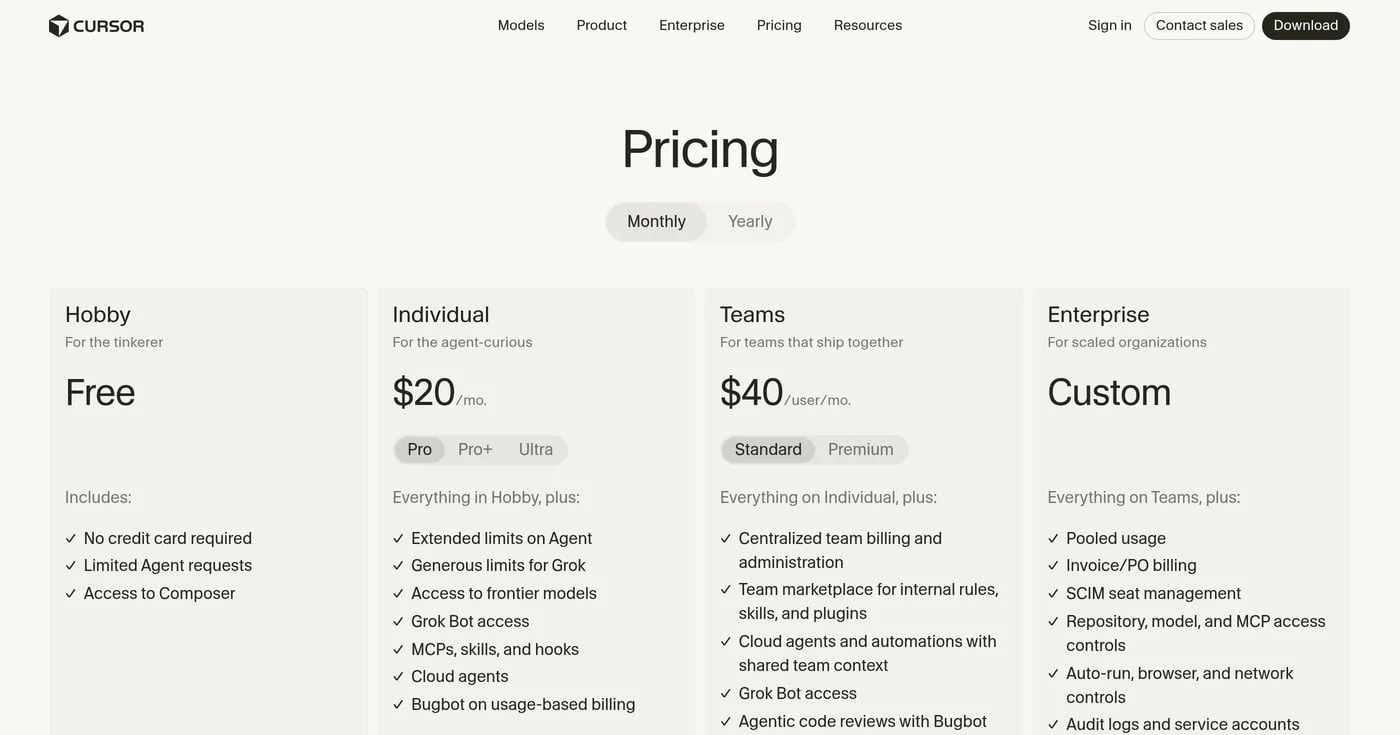
The marketing page prints Hobby Free, Individual $20 (with a Pro / Pro+ / Ultra toggle), Teams $40 (with a Standard / Premium toggle), and Enterprise custom. It does not print $60, $200, or $120 as the default card.
The help table is the sticker the card hides:
Plan | Monthly price |
|---|---|
Hobby | $0 |
Start (India only) | ₹649, tax inclusive |
Pro | $20 |
Pro+ | $60 |
Ultra | $200 |
Teams Standard | $40/user |
Teams Premium | $120/user |
Enterprise | Custom |
Hobby is free, no credit card, limited Agent, Composer access. Stay here if you are testing whether Tab is enough.
Pro is the $20 floor. Vendor guidance on models and pricing: daily Tab stays in $20; limited Agent often stays in $20; daily Agent typically lands at $60-$100 total; multi-agent power users land at $200+.
That band is why Pro+ exists. Cursor published it as guidance.
Pro+ at $60 is the daily-Agent SKU. If you open Agent every working day and third-party models keep emptying the Other Models pool, you are already off Pro.
Ultra at $200/mo launched 16 June 2025 as 20× Pro usage. It is a power-user pool.
Ras Mic walks the same ladder on video: $20, $60, and $200. Stay off frontier models and the Grok/Composer pool on $20 starts to last.
Teams is governance: SSO, seat types, spend limits, and (on Enterprise) pooled usage. Teams does not discount the Individual SKUs.
Mix Standard and Premium freely. Premium is a seat type inside Teams.
Cursor Start is India-only at ₹649/mo, tax inclusive, paid in INR. Cursor models only: no Auto, no third-party, no Bugbot, no SDK, no automations, no on-demand.
Upgrade to Pro or Teams (or Pro+ / Ultra) is one-way. You cannot downgrade back to Start. Start sits on the help table and signup, not on the marketing card.
Pro, Pro+, and Ultra include two monthly usage pools. Start includes the Cursor Models pool only.
Unused usage does not roll over. Current usage-based plans do not include Max Mode.
Cursor Models covers first-party models (Grok 4.6, Grok 4.5, and Composer 2.5 in the current docs). Cursor does not publish a dollar size. Staff have said the included allocation can be worth more than the $20 sticker.
Forum community reconstructs this pool as roughly 5× the Other Models quota. That 5× figure is community math.
Other Models covers third-party models at list API prices. Official docs now say individual plans include at least $20 of third-party usage each month, with more on higher tiers. The live plan table still prints only "Included" next to each SKU.
Independents and Ultra staff Kevin Neilson (May 2026) still quote Pro+ $70 / Ultra at least $400. Treat those as attributed snapshots.
On-demand starts after the relevant pool empties. Individuals must enable it. Teams has it on by default.
Cursor bills a separate invoice at API rates ("no markup" in vendor language). Teams and Enterprise still add a Token Rate of $0.25 per million tokens on third-party usage, including Auto-routed calls and BYOK. First-party Grok and Composer are exempt.
The 500-request Pro plan died on 16 June 2025. Old Pro was 500 "fast premium requests" (Sonnet counted as 2). New Pro is $20 of frontier usage at API prices.
CEO Michael Truell's 4 July 2025 apology is the primary source. Cursor offered refunds for 16 June-4 July via pro-pricing@cursor.com. Then-median claims (~225 Sonnet 4, ~550 Gemini, ~650 GPT 4.1) are 2025 medians, not a 2026 SLA.
TechCrunch reported users burning the $20 pool in hours on Claude, with Auto as the only "unlimited" path at the time.
Auto was unlimited for individuals from June to September 2025, then started counting against included usage (12 August 2025 blog, effective next renewal after 15 September 2025). Official Auto now bills at list price of the routed model.
An Auto Cost row still sits on the docs table at $1.25 in / $0.25 cache-read / $6 out, marked hidden by default. That row is not the Auto invoice.
First-party list rates on the docs table, per million tokens: Composer 2.5 at $0.50 in / $0.20 cache-read / $2.50 out; Grok 4.5 at $2 / $0.50 / $6. Grok 4.6 has been named on usage-limits at the same $2 / $6 as 4.5. Do not freeze 4.5 vs 4.6 in your budget.
When you hit the cap, the path is: included pool → on-demand if enabled → spend limit → wait for reset. Cursor publishes monthly pools and rate limits. There is no public daily cap.
Quiet Pro users treat $20 as a month of Tab plus light Agent. A one-year Auto user on the forum said $20 usually lasts a month. u/jpea in r/cursor (September 2025) put the same pattern in a sentence you can take to finance:
"I gladly pay $20 for a personal account, and approved paying $40/mo for all 50+ people where I work. ... I'm a 20+ year dev and I never hit the prompt limit. I would pay $10k a year for this. But I'm at $240/yr."
A daily Agent user is already off Pro, onto Pro+ or Pro plus on-demand.
A 4 August 2026 Pro+ thread is a 2026 invoice you can quote. Cursor Models lasted about 2.5 weeks on Grok 4.5 High. Other Models leftover died in 2 days, then on-demand ran $32 in 4 hours.
Ultra buyers who stay on Opus still overage. u/sprfrkr in r/cursor (May 2026) spent $1,000 in tokens above the $200 Ultra plan on nearly all Opus, then flipped to 70% Composer 2.5 / 30% Opus.
Composer 2.5 is the 2026 cost-control default. Frontier models are the cursed-bug SKU.
Grok Bot on Pro is the wrong add-on. u/DeCiel in r/cursor (September 2026) hit 100% weekly usage in 2 days, added $10 on-demand, and burned it in 2 hours.
If Grok Bot is daily, budget Pro+ or Ultra. Do not "test" it on Pro with a $10 top-up.
On r/cursor, the recurring confusion is treating Pro as a hard $20 product. Replies split between "on-demand is off by default, skill issue" and "the UI will not take a $0 cap." Disable on-demand in Dashboard → Billing / Usage if you need a hard stop.
A spend limit of $0 while on-demand is on is not a reliable cap. Enforcement is not instant, and raising a cap mid-cycle can rebill previously credited overage.
Leonardo Grigorio's cost video frames the same trap as API-credit-shaped included usage. On Cursor Pro he counted about 3.3 million tokens per month on an expensive model (Claude Sonnet 4.5), versus 4-6 million if you stay on GPT-5 Codex. If your month is Claude Sonnet, you are buying API list price inside an IDE.
Annual Individual billing is a dashboard toggle. Help says you cannot switch yearly to monthly mid-plan. Cursor does not print Individual annual dollars on the help table.
Independents treat 20% off as Pro $16/mo ($192), Pro+ $48 ($576), Ultra $160 ($1,920). Reddit $14/mo yearly is unverified. Use the live dashboard toggle.
Students start on Hobby. Official /students says look out for promotions at on-campus and online events.
There is no standing year of free Pro. Older "free Pro for a year" posts are fossils.
Ranking pages print $40/user and stop.
As of the June 2026 Teams blog (new customers immediately; renewing cycles from 1 July 2026), Standard stays $40/user/mo and gets more included usage, including dedicated Composer. Premium is 5× usage at 3× price: $120/mo or $96 annual.
Vendor copy says the Composer pool on Premium covers heavy agent for 99% of users. That 99% is vendor, not measured.
Annual official rates: Standard $32/user ($32/mo billed yearly), Premium $96/user ($96/mo billed yearly).
The line "$40 includes only $20 of agent usage" is the 12 August 2025 Teams post. Dual pools plus more included usage at the same $40 is the card from 1 July 2026.
Two pools attach to each paid seat. Usage does not transfer between members. It resets on the team billing cycle.
Enterprise is the pooled SKU.
On-demand is enabled by default. When Other Models runs out, Cursor moves the member onto Cursor Models. Further third-party use, or an emptied Cursor Models pool, goes to on-demand if it is on.
The easy miss in Teams TCO is the Token Rate: $0.25 per million tokens on third-party input, output, and cached tokens, including BYOK. First-party Grok and Composer skip it. A team that "just uses Claude" pays list plus $0.25/M on every token.
Billing is active-seat, not pre-allocated. Add mid-cycle and you are pro-rated. Remove a seat after it has used credit and it stays until cycle end.
Unpaid Admin is $0 and has no Cursor access. There is no minimum seat count. Mix Standard and Premium on the same team.
Worked example from those official annual rates, 10 seats: 2 Premium + 8 Standard = (2 × $96) + (8 × $32) = $448/mo. All-Premium is $960/mo.
That $448 is seat math Cursor did not publish. It ignores on-demand plus Token Rate. The third-party pool still dries faster than Composer.
Cursor Router is the Teams and Enterprise Auto routing system. Cursor's launch post claims 60% savings at frontier-quality performance in vendor A/B tests. It is currently Teams and Enterprise only.
Enterprise starts with the router off; an admin must opt in. Treat 60% as vendor copy.
Named LinkedIn customers (Coinbase, Nokia, Wayfair, Vercel, PayPal, IMDEX) are vendor ROI stories. Seat counts and "millions of dollars" are not independently measured spend.
The spend range on Reddit is wide. u/jpea's $40 × 50+ that never hit the prompt limit is the quiet success. u/ElectroStaticSpeaker in r/cursor (June 2026) is the outlier caution:
"We had a user in our org bill $35k one month by choosing the wrong models. $41? lol"
$35k is not typical. It is what default-on on-demand plus the wrong model looks like without a spend limit.
Set team-wide spend limits. Per-member limits are an Enterprise feature. Volume deals go to enterprise@cursor.com.
If you already model usage-based tools, the shape matches Apollo pricing (credits vs sticker) and Mixpanel pricing (the meter that doubles the bill). Webflow pricing is the other stacked-plan cousin: one card, several SKUs.
Staff (Dean Rie, 1 May 2026) decoded the dashboard in a billing thread: Spending % (Auto / API) is the Pro quota. Usage $ is an informational estimate of retail value.
Usage $ can exceed the $20 sticker because included allocation can be worth more than list. It does not bill you.
Watch Spending % and ignore Usage $ for billing. On-demand off means no extra invoice. At 100% Spending % you are rate-limited instead.
Most pricing recaps reprint Auto token rates and skip which dashboard number is the invoice.
Forum threads about accidental annual upgrades are a billing-UX cluster. Confirm the cycle before you hit upgrade.
Bugbot on Individual is usage-based as of the 11 May 2026 blog. Older $40/user Bugbot prices are fossils. Teams still includes agentic reviews, billed from on-demand spend after the June 2026 renewal cutover.
Cloud agents are a usage line, not a second plan. Max Mode is not in current usage-based plans.
/pricing alone.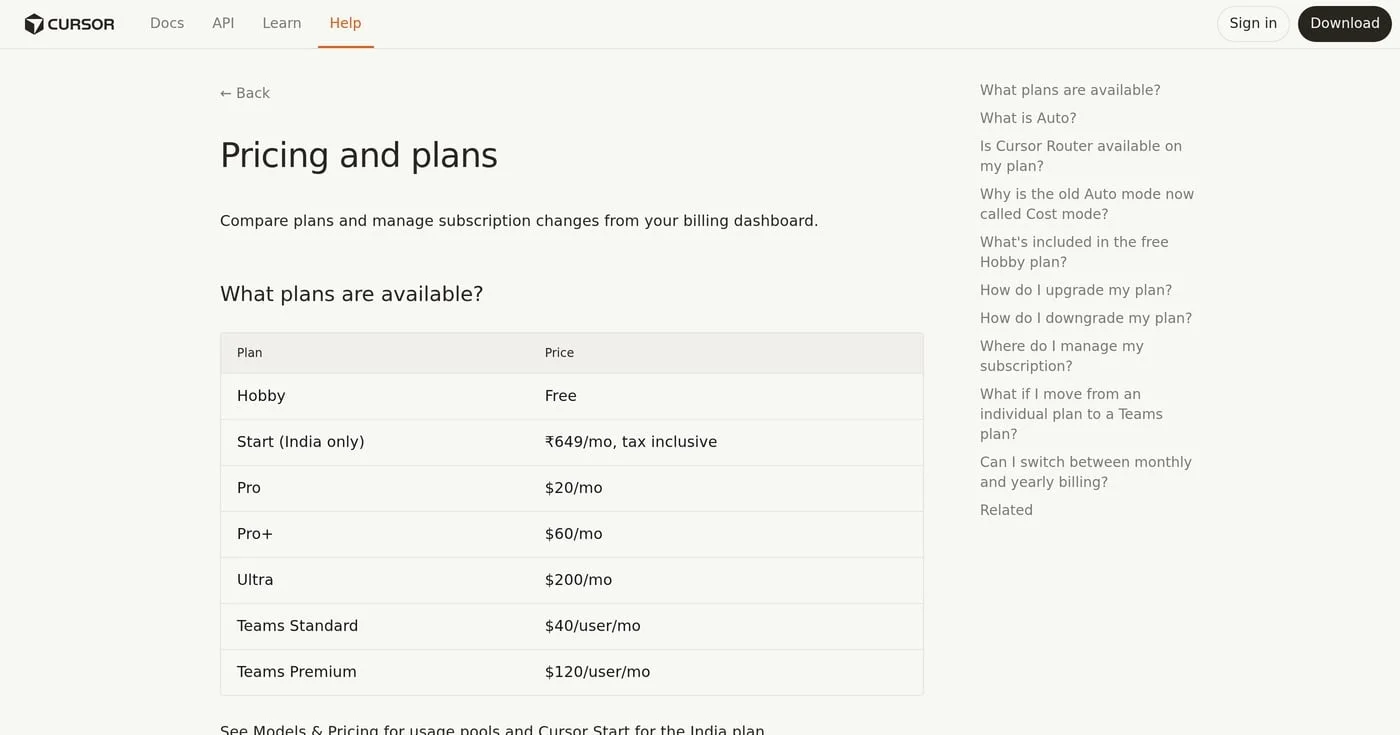
Plan | Price | Key limits | Best for |
|---|---|---|---|
Hobby | $0 | Limited Agent, Composer | Trying Tab |
Start (India) | ₹649/mo | Cursor models only, no on-demand | India, first-party only |
Pro | $20/mo | Two pools, unlimited Tab | Tab + light Agent |
Pro+ | $60/mo | Larger included usage | Daily Agent |
Ultra | $200/mo | 20× Pro usage (launch terms) | Multi-agent / API-credit bundle |
Teams Standard | $40/user/mo ($32 billed yearly) | Dual pools, no usage transfer | Most seats |
Teams Premium | $120/user/mo ($96 billed yearly) | 5× Standard usage | 1-2 power users |
Enterprise | Custom | Pooled usage, per-member limits | Invoice, SCIM, volume |
See live Cursor pricing and the plan table. Taxes extra. Cursor says no resellers.
Is it expensive? Relative to GitHub Copilot Pro at $10, the Cursor Individual floor is 2×. Copilot's included credits are $15 / $70 / $200 on Pro / Pro+ / Max (1 credit = $0.01).
Cursor's $20 is a two-pool agent IDE. Copilot is credits plus completions. Copilot Business is $19/seat; Enterprise is $39/seat.
Relative to Claude Code, Claude Pro is $20/mo ($17 annual) and Max starts at $100/mo. The free Claude plan does not include Claude Code.
Anthropic's Claude Code docs cite about $13 per developer per active day and $150-$250 per developer per month across enterprise deployments, with 90% below $30/active day. Forum anecdotes of $1,500-$2,000/mo Cursor vs $200 Claude Max are attributed outliers, not a typical split.
The June 2025 change is why "Cursor got expensive" ranks. Billing moved from 500 requests to credits, then Agent token burn did the rest. Ultra is 20× Pro usage, not a 20× list-price hike, and Teams Premium is 5× usage at 3× price.
Cursor is ideal for:
Cursor is NOT ideal for:
If this invoice is wrong for you:
Pay $20 when Tab is the product and Agent is occasional, $60 when Agent is daily, and $200 after on-demand would have cost you more. For teams, mix Standard/Premium, turn Router on, and cap on-demand before a $35k month.
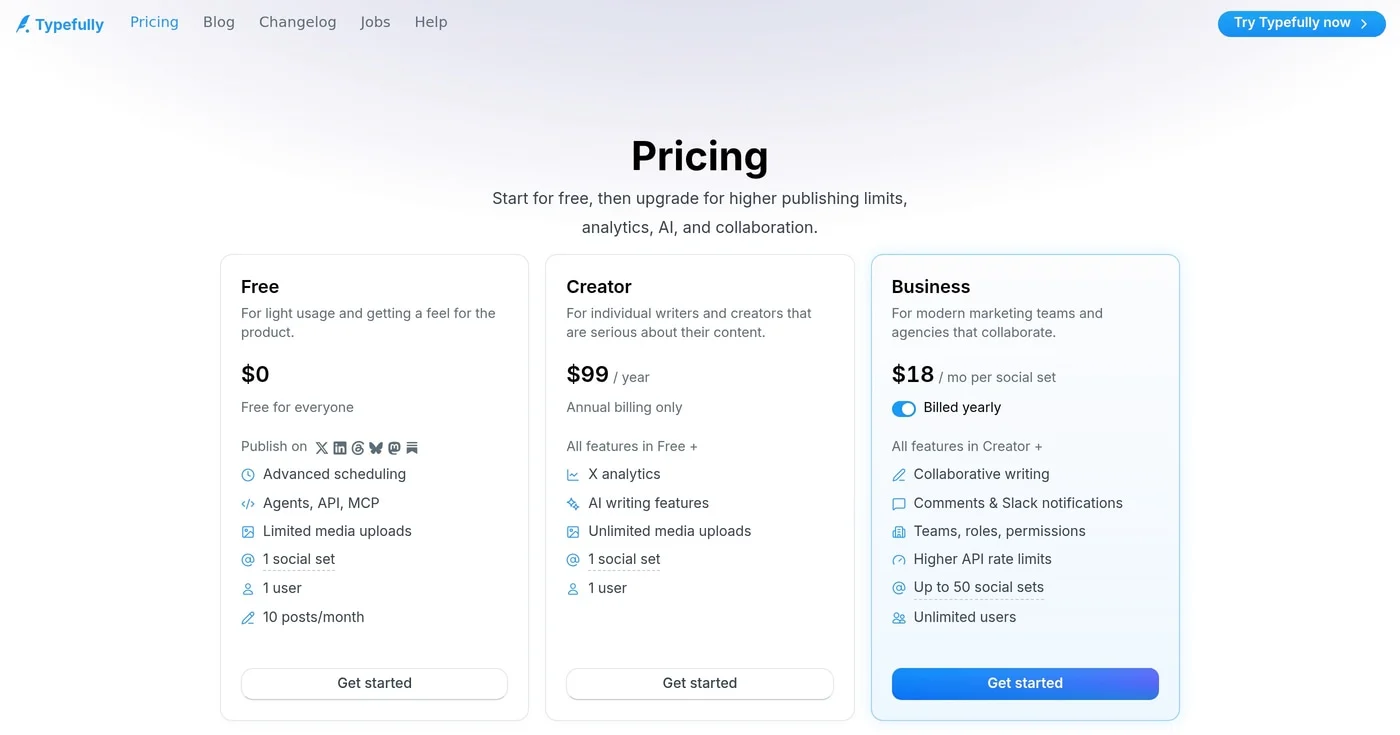
Free is $0, Creator is $99/year, and Business is $18 per set. Typefully pricing still excludes X Premium, LinkedIn analytics, and a monthly Creator bill.
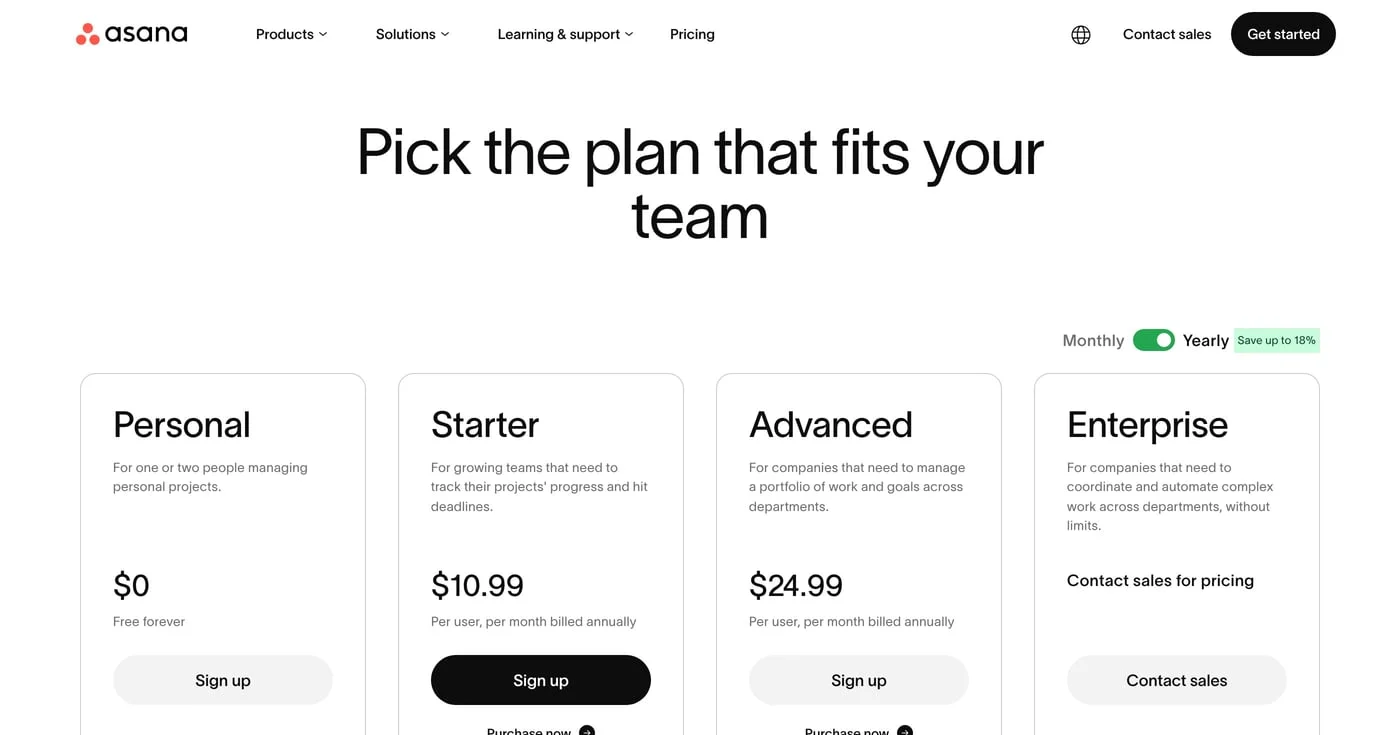
Asana pricing review: Starter is $10.99/user/mo yearly, but paid plans start at 2 seats and 6 people bill as 10. Plans, invoice math, monday.com vs ClickUp.
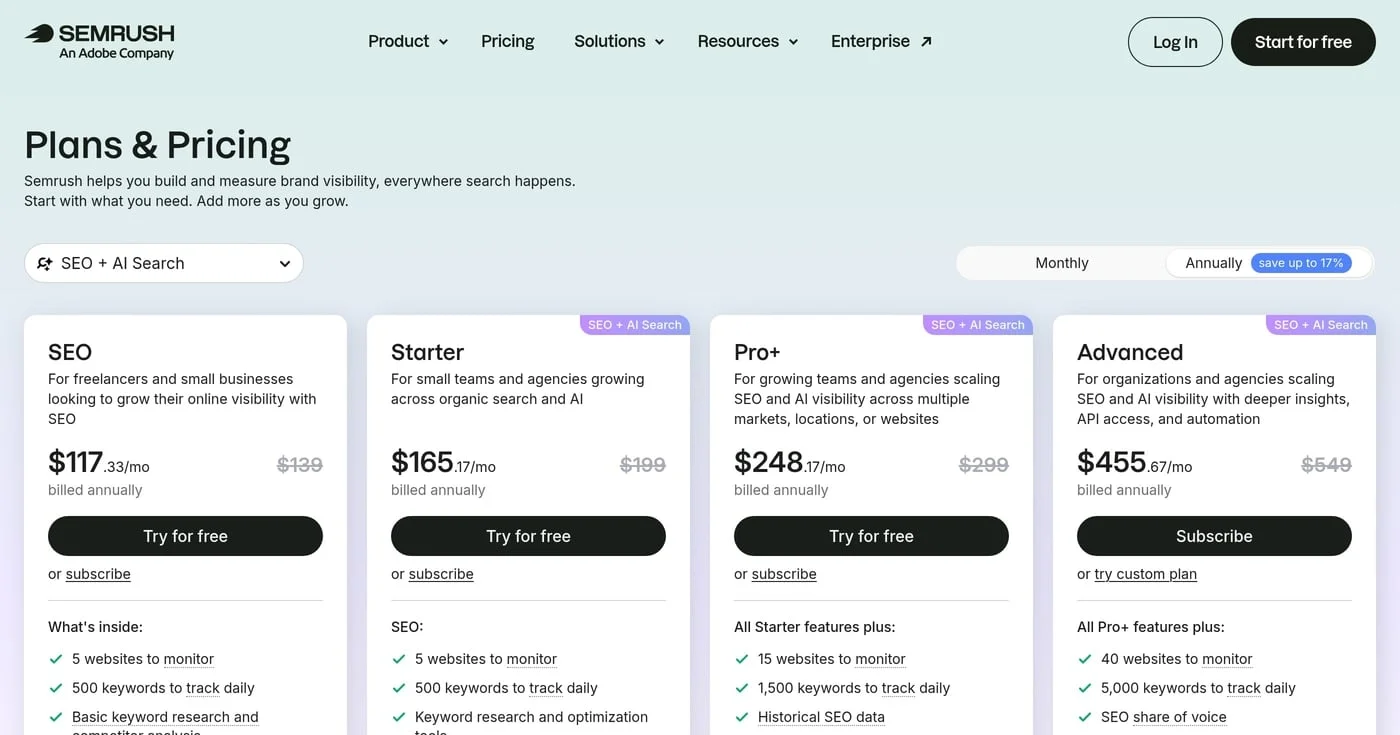
As of September 2026, Semrush SEO is $139/mo and Starter is $199. One seat is included; extra users, $99 AI Visibility, and toolkits set the real invoice.
